A 25-member creative agency in Kolkata. Solid client work. Happy retainers. A culture that looks fine from the outside. And still, every six to eight months, the best people leave.
Not the passengers. The engines.
They say they are not growing fast enough. The founder responds with the standard toolkit: revised roles, better salaries, reshuffled teams. Nothing sticks. Six months later, another exit interview. Another LinkedIn post about "exciting new chapters."
This is not a Kolkata problem. It is an agency employee retention problem that runs across cities, team sizes, and verticals. If you have led a creative agency past the fifteen-person mark, you have seen some version of this loop. The specifics change. The pattern does not.
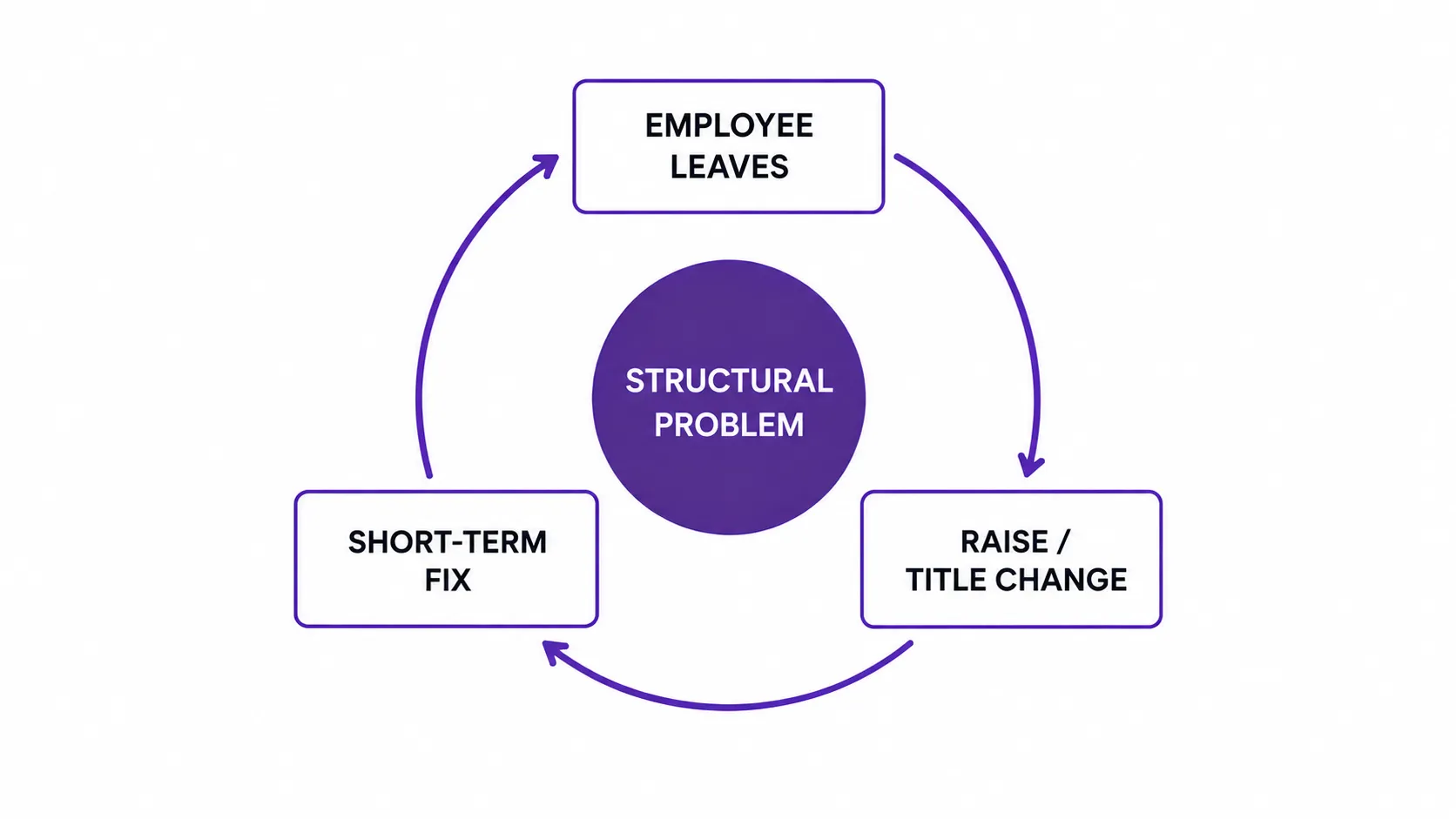
The instinct is to fix what is visible. The salary was not competitive, so we revised it. The role felt stale, so we changed the title. The team dynamics were off, so we moved people around. Each fix makes sense in isolation. Each fix addresses the symptom the departing person named on their way out.
And that is precisely the trap. Exit conversations are curated. People leaving a team they liked will soften the real reason. People leaving a founder they respected will default to the safest explanation: money, growth, opportunity. These are not lies. But they are rarely the full picture, and building retention strategy on half-truths is how founders end up cycling through the same fixes for years.
Why best employees leave agencies rarely maps to what shows up in exit conversations. Because the visible problem is almost never the structural one.
The standard retention playbook treats every departure as the same disease. Someone leaves, so the agency patches the surface. Better package, bigger title, new reporting line. On paper, these are logical moves. In practice, they keep failing because they assume motivation is uniform across the team.
It is not.
India's advertising industry runs talent attrition rates between 35 and 40 percent, according to Storyboard18's reporting on the sector. That number has barely moved in years despite agencies revising compensation cycles, adding wellness perks, introducing hybrid work. The toolkit keeps expanding. The attrition rate stays flat.
The reason is structural. Raises solve for money. Title bumps solve for status. Neither solves for the person who is actually leaving because they cannot see where they fit in the agency's next chapter. And when you apply a money fix to a meaning problem, you buy yourself three months at best.
There is also a compounding effect that founders rarely account for. When one strong person leaves and the fix is a blanket compensation revision, the people who stay learn something. They learn that the way to get a raise in this agency is to signal that you might leave. The retention strategy becomes reactive, and the culture shifts from one where people earn growth to one where people negotiate under threat. The agency starts retaining bodies but losing commitment, which is a slower and more expensive form of the same attrition.
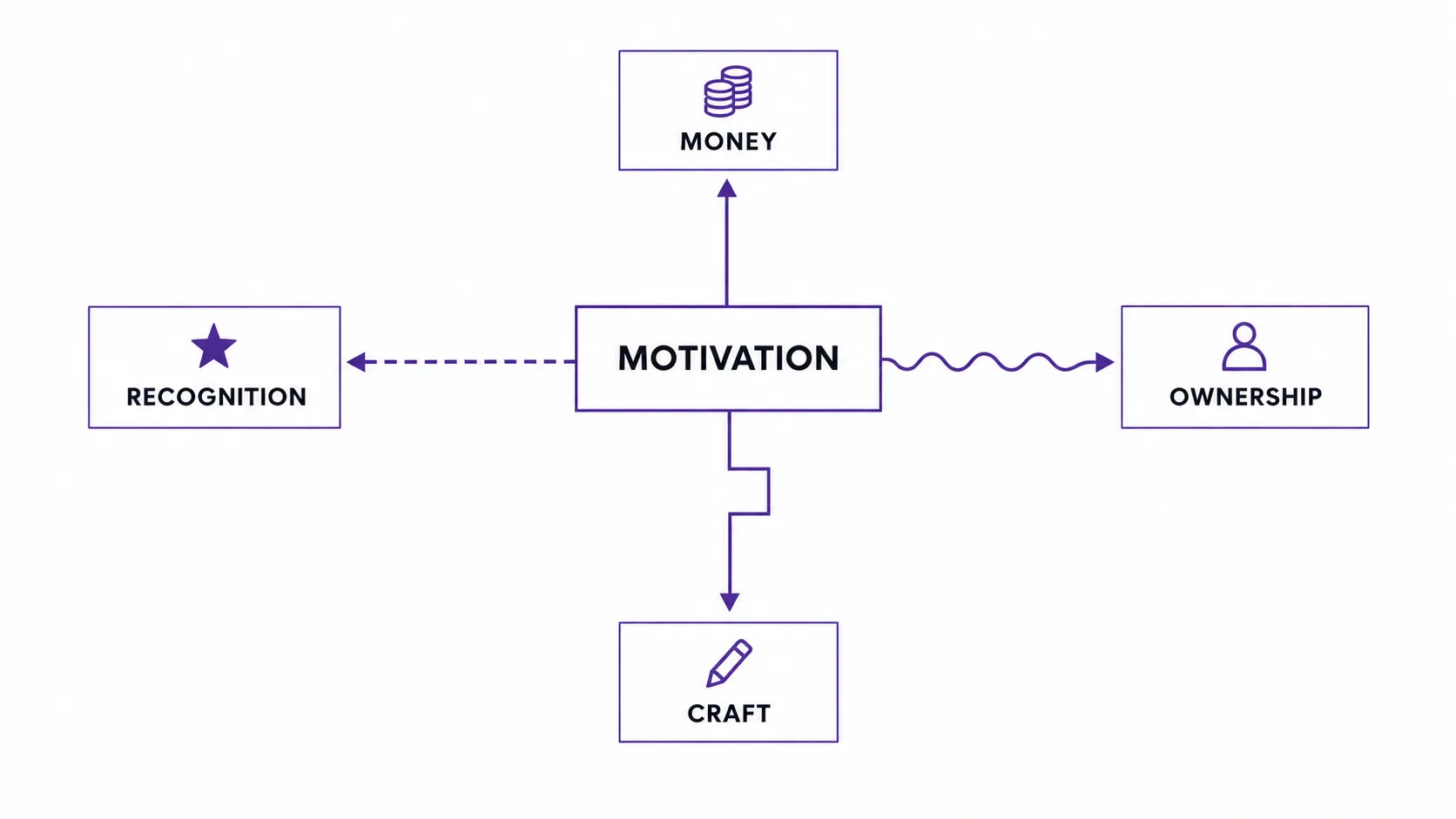
Here is what most founders miss. The word "motivation" gets treated as a single variable. Either someone is motivated, or they are not.
Motivations are as unique as the individual. For some, it is money. For others, it is social recognition, a visible seat at the table, their name on the pitch deck. For a third, it might be a better designation, a title that signals progress to the outside world. And for many, it is a combination of factors that shift over time.
The founder who loses good people every six to eight months is often someone who has defaulted to a single retention lever. Usually compensation, because it is the most legible and the easiest to action. But when you keep pulling the same lever for people who are driven by entirely different things, the lever stops working. Not because it is the wrong lever in absolute terms. Because it is the wrong lever for that specific person.
Individual motivation retention is not a framework you install once. It is a practice. A continuous read on what each person on your team actually cares about, updated as their life and ambitions evolve.
The designer who joined for craft depth two years ago might now want client-facing exposure. The account manager who initially wanted financial stability might now be ready for a leadership challenge. Motivation is not a static profile. It shifts with life stages, with confidence, with what the person sees peers doing outside the agency. A retention strategy that reads motivators once and files them away is only marginally better than one that never reads them at all.
When your team cannot see themselves in the agency's future, they start building their own.
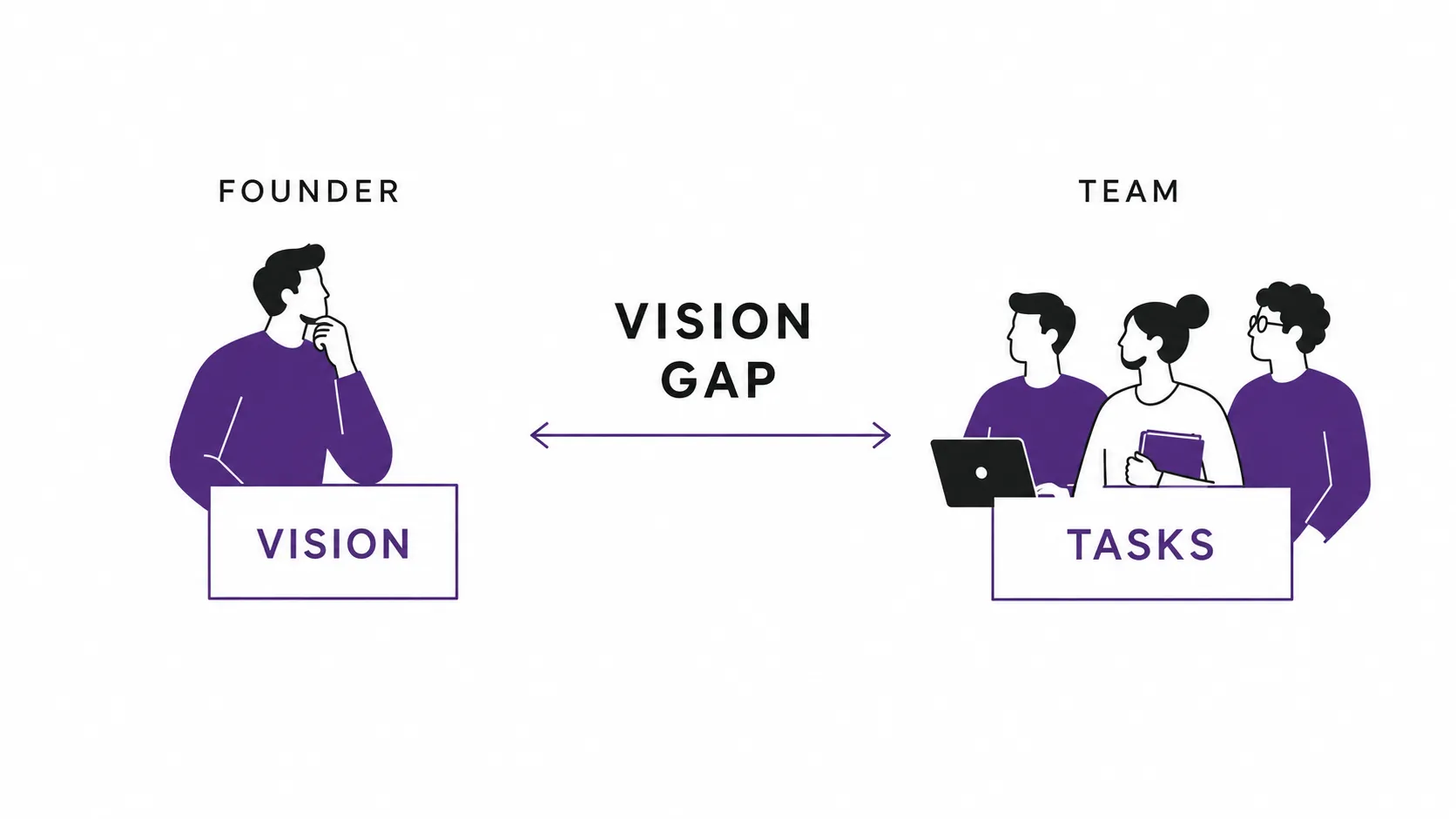
This is the second structural problem. Even when individual motivators are met on paper, retention breaks down if the team has not bought into the founder's vision. And buying in does not mean agreeing with the business plan. It means seeing, concretely, where their own growth connects to the agency's growth.
Most agency founders carry a vision in their heads. A direction for the next two years. A thesis on where the industry is moving and how the agency should move with it. But they rarely translate that vision into something the team can locate themselves inside. The strategy deck goes to clients. The team gets tasks.
This is not negligence. It is a blind spot born from proximity. The founder lives inside the vision daily, so it feels obvious and shared. But what is obvious to the person setting direction is invisible to the person executing deliverables. The senior designer does not know the agency is pivoting toward brand strategy. The account lead does not know the founder is building toward a consulting model. They see their current projects, their current title, and the ceiling directly above them.
When people cannot map their own trajectory onto the agency's trajectory, they default to the only growth signal they can control: leaving for a bigger title somewhere else. The exit is not a rejection of the agency. It is a response to a gap the founder never closed.
The diagnostic is clear. Individual motivators go unread, and the agency's vision stays untranslated. The fix is not complicated, but it is uncomfortable because it requires the founder to do work that does not scale.
Step one: map individual motivators. Not through an annual survey. Through direct, recurring conversations that name the question plainly. What is driving you right now? What does growth look like to you in the next twelve months? What would make you stay, and what would make you leave? These are not HR questions. They are founder questions. The answers will not be uniform, and that is the point.
Step two: build growth trajectories, not career ladders. Career ladders assume linear progression. Designer to senior designer to design lead to creative director. But motivation is rarely linear. The designer who wants social recognition needs a different path than the designer who wants deeper craft mastery. Growth trajectories are personalised routes that connect what the person wants to where the agency is going.
This does not mean creating twenty different career paths for a twenty-person team. It means having enough flexibility in how you define roles, projects, and visibility that each person's next twelve months feel designed rather than default. A strategist who wants autonomy gets a client vertical to own. A designer who wants recognition gets their name on case studies. A project manager who wants financial growth gets tied to a revenue outcome. The shapes are different. The principle is the same: the next step should feel like it was built for them, not borrowed from a template.
Step three: sell the vision internally with the same energy you sell it externally. Clients get the strategy presentation. The team should get something equivalent, not a town hall with vague optimism, but a concrete picture of where the agency is headed and what role each person plays in getting there. When people can see their contribution in the larger arc, they stop treating the agency as a stepping stone and start treating it as a vehicle.
This is the approach we have seen work at The Cofoundry with the agency founders we work with. The ones who retain their best people are not the ones paying the highest salaries. They are the ones who have distributed thinking beyond themselves and given their teams a reason to stay that compensation alone cannot replace.
The uncomfortable truth about talent attrition in creative agencies is that it is rarely an HR problem. It is a founder problem.
HR can administer exit surveys. HR can benchmark salaries. HR can build onboarding flows and wellness calendars. What HR cannot do is get each person on the team to buy into a vision that the founder has not yet articulated. What HR cannot do is understand that the mid-level strategist who just resigned was not leaving for more money but for a role where she felt her thinking mattered.
This connects to a broader pattern we keep seeing with agency founders. The ones who struggle with unclear ownership structures are often the same ones who struggle with retention, because both problems trace back to the same root. The team does not know where they stand. Not in terms of hierarchy, but in terms of purpose.
Retention, done right, is not a policy. It is a posture. A founder who regularly reads individual motivators, translates their vision into something the team can see themselves inside, and builds growth paths that are personal rather than procedural, that founder keeps people. Not forever. But long enough that the leaving, when it happens, is about genuine ambition rather than unmet needs.
And there is a meaningful difference between those two kinds of departures. When someone leaves because they have genuinely outgrown what the agency can offer, that is a graduation. It reflects well on the agency, often generates referrals, and sometimes produces a future client. When someone leaves because they never understood where they fit, that is a failure. It costs the agency institutional knowledge, client continuity, and six months of rebuilding.
The agency in Kolkata does not need a better exit interview process. It needs a founder who understands that the best people do not leave because the agency is bad. They leave because no one showed them why staying would be better.
This blog is based on The Cofoundry's AMA series where agency founders ask real questions about growth, teams, and leadership.
Competitive pay solves for only one motivator. Many high performers leave because they cannot see a personal growth path tied to the agency's direction. When raises address a money gap but the real issue is a meaning gap, the fix does not hold beyond a few months.
Through direct, recurring conversations, not annual surveys. Founders should ask plainly: what does growth look like for you, what would make you stay, and what would make you leave. The answers differ across the team, and that variation is the insight.
A career ladder assumes linear, title-based progression. A growth trajectory is personalised. It connects what the individual actually wants, whether that is craft depth, visibility, autonomy, or financial growth, to a specific path inside the agency's future plans.
HR can benchmark salaries and run exit surveys, but it cannot articulate where the agency is headed or show each person where they fit inside that future. That translation work is the founder's job, and skipping it is usually the root cause of attrition that standard HR interventions cannot fix.
When people do not know what decisions they own or how their thinking shapes the agency's output, they default to the only growth signal available: leaving for a bigger title elsewhere. Clear ownership gives people a stake in the outcome, not just a seat in the room.