When do you stop firefighting and start strategising. Where does hustle end and process begin. How do you build a culture people actually own. What do you delegate, and what do you keep. When do you hire an executor, and when do you need a manager.
We hear a version of these five questions from nearly every agency founder we sit down with. Not as a checklist. As whichever one is burning that quarter. A founder drowning in client calls asks the first. A founder watching a talented hire flounder without a rulebook asks the third. A founder who just made a bad hire asks the fifth.
Five different founders, five different moments, five different-sounding problems.
It is the same problem five times.
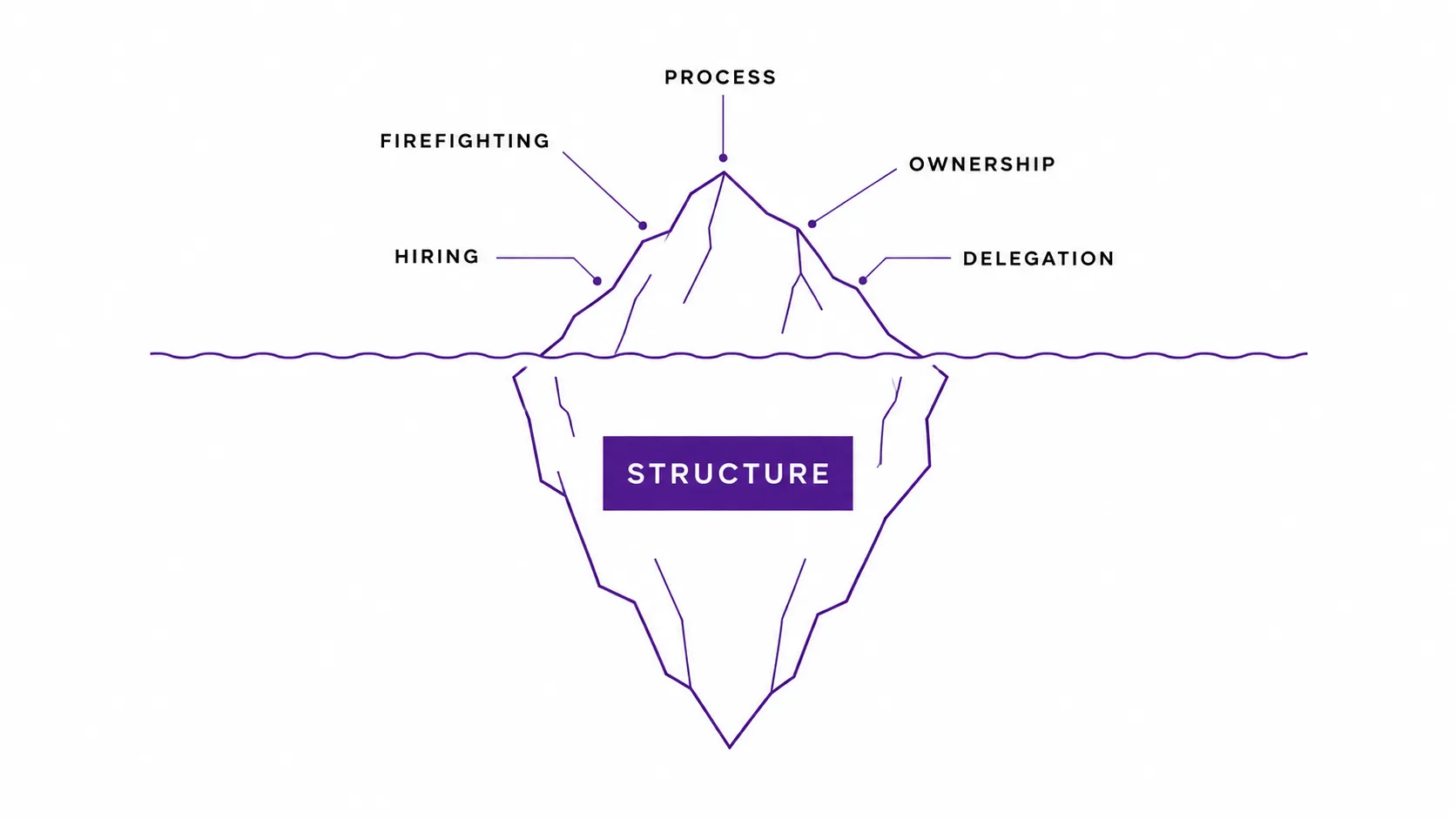
Agency founder scaling problems almost never show up as a single crisis. They show up as this scattered list, each one feeling urgent and specific on its own. What connects them is easy to miss because the founder is standing too close to see it: every one of these questions is really asking the same thing. What structure am I supposed to build so this agency stops running through me.
Founders treat the shift from firefighting to strategy as a willpower issue. Block the calendar. Say no to more calls. Read the right book on deep work. None of it holds, because firefighting is not a time management failure. It is what happens when the agency has no structure capable of catching problems before they reach the founder's desk.
At a certain size, every escalation still routes to one person by default, not by design. The account goes sideways, and the founder gets pulled in, not because the situation demands the founder specifically, but because no one else has the authority to make the call. Firefighting versus strategising is really a question of where decision rights sit. If every meaningful decision requires the founder's sign-off, the founder will spend every day reacting, no matter how disciplined their calendar looks.
The agencies that make this shift do not do it by working harder at strategy. They do it by pushing decision rights down to the level where the information already lives, so problems get caught and solved two steps before they would have reached the top. Strategy time is not protected by willpower. It is protected by structure that stops routing everything upward in the first place.
Most founders frame this as a binary. Hustle got us here. Process will slow us down. Or the reverse: we have grown past hustle, now we need process. Both framings are wrong in the same way.
Hustle and process are not stages an agency passes through. They are two different jobs, and confusing them is what actually slows growth down.
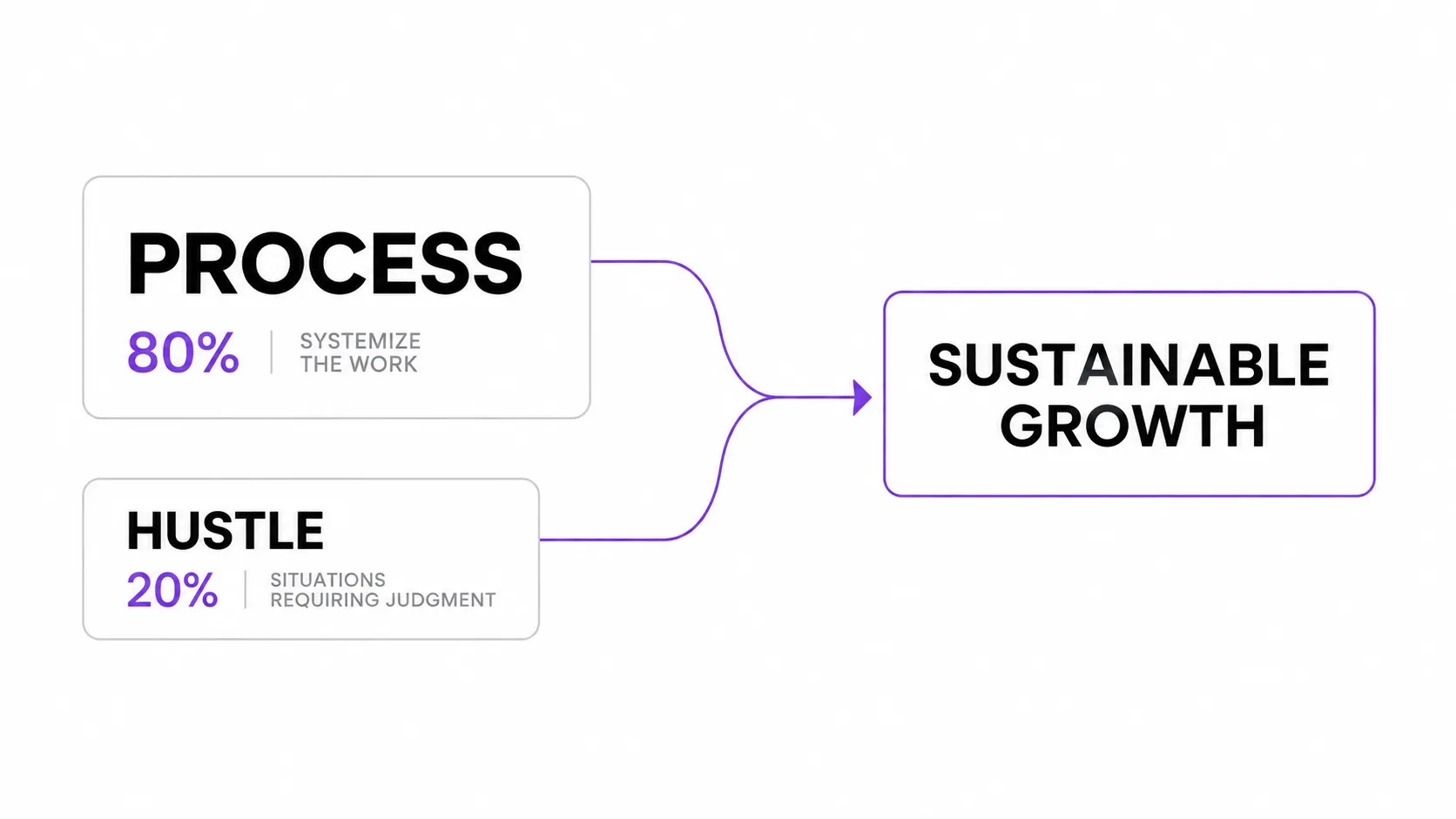
Hustle is what gets a specific deal closed, a specific fire put out, a specific client saved on a Friday evening. Process is what makes sure the next deal, the next fire, the next Friday does not require the same heroics. An agency that runs entirely on hustle burns out its best people, because heroics are not repeatable and everyone eventually notices they are the one being asked to perform them. An agency that runs entirely on process loses the responsiveness that won it clients in the first place.
The agencies we have seen scale cleanly do not choose one. They build enough process to make 80 percent of decisions boring and predictable, freeing hustle for the 20 percent that genuinely needs it, a new business pitch, a crisis with a marquee client, a moment that calls for judgment rather than a playbook. Process is not the opposite of hustle. It is what makes hustle sustainable instead of constant.
Ownership culture in agencies does not come from a values slide or a town hall. Founders announce it constantly. "We're an ownership-driven team here." The words rarely change behaviour, because ownership is not a belief you install. It is a set of conditions you build.
People act like owners when three things are true. They can see how their decision connects to an outcome that matters. They have the actual authority to make that decision without checking upward first. And they carry some consequence, positive or negative, tied to how it plays out. Take away any one of these and the announcement of ownership culture becomes a slogan on the wall while the actual behaviour in the building stays exactly the same.
This is why two agencies can say the identical words in their onboarding deck and produce completely different cultures eighteen months later. One gave a strategist an account to run end to end, with real budget authority and a real stake in its growth. The other kept every meaningful call with the founder and called the strategist's cheerleading "ownership." Culture is not what an agency says about itself. It is what the org chart and the decision rights actually allow.
This is the question that costs founders the most sleep, because the honest answer is not "delegate everything except what only you can do." Nearly everything can technically be done by someone else. The real question is narrower and harder: what should never leave the founder's hands even once the agency can afford to hand it off.
We think about it in three buckets.
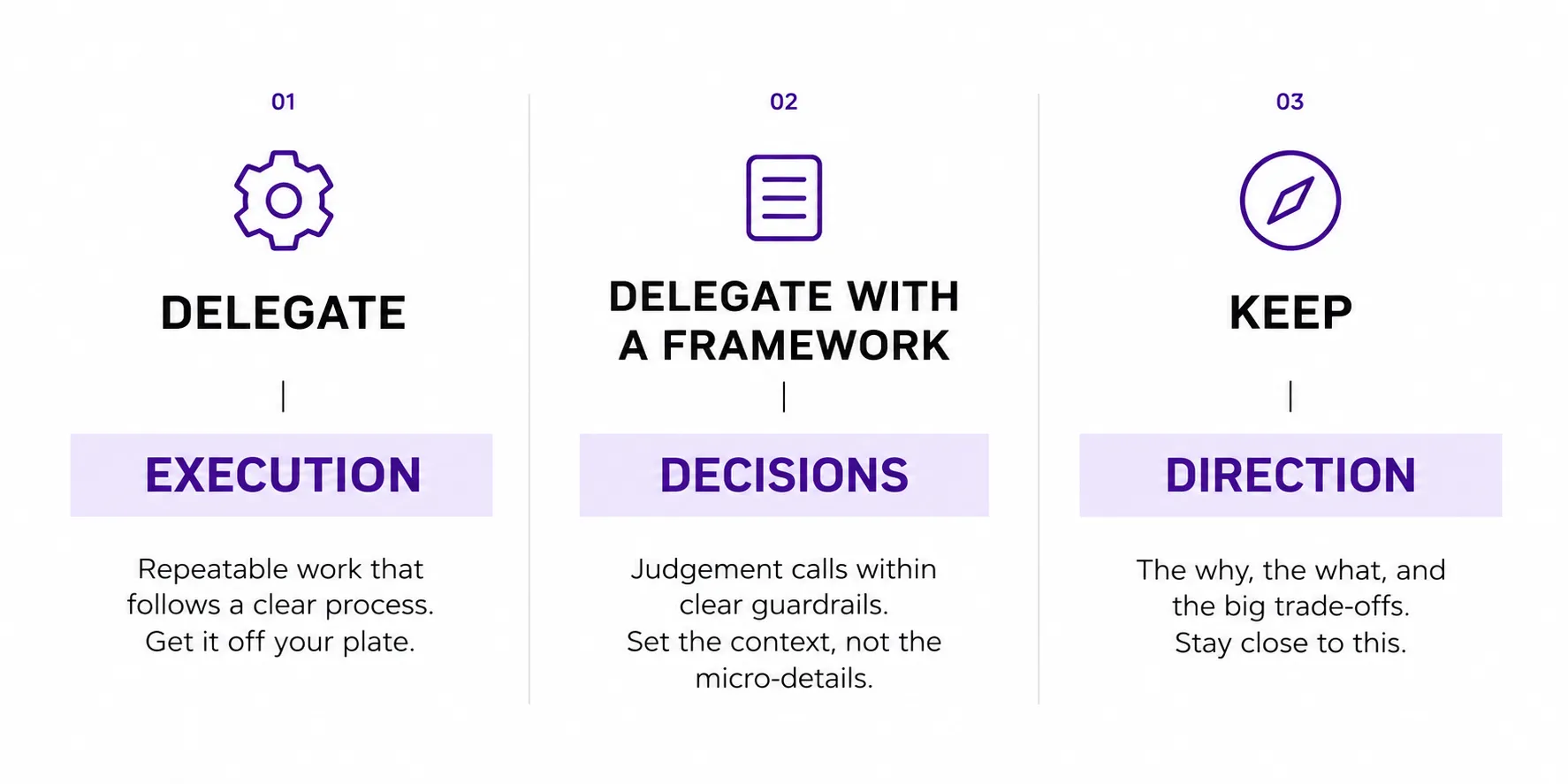
Delegate execution fully, the client deliverables, the campaign builds, the day-to-day account management. This is where most founders already delegate, often reluctantly and late. Delegate decisions with a framework, hiring calls, pricing on smaller accounts, resourcing tradeoffs, once the founder has clearly written down the principles those decisions should follow. This is the bucket most agencies skip entirely, which is why delegated decisions keep bouncing back for the founder's approval anyway. Never fully delegate the agency's direction, who the agency serves, what it refuses to become, where it is headed in three years. That is not a task. It is the founder's actual job, and no amount of scaling changes that.
We wrote more on this distinction, between distributing tasks and distributing the thinking behind them, in The Founder Bottleneck. The short version is that most founders delegate the work and quietly keep the thinking, then wonder why the agency still cannot move without them.
Executors versus managers looks like a hiring decision. It is actually a structure decision wearing a job description.
An executor is excellent at doing the work in front of them. A designer who ships beautifully. A media buyer who optimises a campaign relentlessly. What an executor is not built to do is decide what work should exist in the first place, or catch a problem before it becomes visible. A manager's entire value is in that layer above the work, setting direction, catching drift early, making the judgment calls an executor is not positioned to make.
The mistake founders make is hiring another excellent executor when what the agency actually needs is someone who can stand between the founder and five executors. They hire for the skill they can evaluate easily, craft, because craft is visible in a portfolio. They hire less often for the judgment that only shows up under pressure, because judgment does not fit neatly into a work sample. The agency ends up with five strong individual performers and zero people capable of running the room without the founder in it.
Look at the five questions again. Firefighting versus strategy is a decision-rights problem. Hustle versus process is a repeatability problem. Ownership culture is a design problem. Delegation is a thinking-transfer problem. Executors versus managers is a judgment problem.
Different words. Same root. Every one of them is asking whether the agency has an operating structure independent of the founder's daily presence, or whether the agency simply is the founder, wearing an org chart for appearances.
This is exactly where The Cofoundry works. Not as a vendor solving one of these five in isolation, a hiring firm for the manager problem, a consultant for the ownership-culture problem, a coach for the firefighting problem. We sit inside the agency as a co-founder would, building the decision rights, the process layer, the ownership conditions, the delegation framework, and the hiring judgment together, because treating them as five separate fixes is how founders end up back at the same five questions a year later.
Not as clients. As partners who have stood exactly where you are standing.
If most of your meaningful decisions still require your direct sign-off, you are firefighting regardless of how your calendar looks. The fix is not better time management. It is pushing decision rights down to where the information already sits, so problems get caught before they reach you.
Hustle solves a specific, one-time problem through effort and judgment. Process makes sure the next version of that problem does not require the same effort again. Agencies that scale well use process to make most decisions predictable, saving hustle for the rare moments that genuinely need it.
Ownership comes from three conditions: people can see how their decision affects a real outcome, they hold actual authority to make that decision, and they carry some consequence tied to the result. Announcing ownership as a value changes nothing if the org chart does not grant any of the three.
Execution should be delegated early and fully. Decisions can be delegated once the founder has written down the framework those decisions should follow. What should never be delegated is the agency's direction, who it serves, what it refuses to become, and where it is headed next.
Hire an executor when the work itself needs doing, a campaign built, a design shipped. Hire a manager when the agency needs someone who can catch problems early and make judgment calls without escalating everything to the founder. Most founders default to hiring executors because craft is easy to evaluate, which is why the manager gap keeps reappearing.