Most founders build their go-to-market in the wrong order, starting with ads and campaigns, when the real work on their first 100 customers begins before a single rupee is spent on marketing.
In most launches, the customer ends up being whoever happens to click. The product is ready, a launch date is fixed, the first budget goes into paid social to see what sticks, and the founder spends the next six months working out why those customers behave so differently from one another.
Skilled founders do not begin by evaluating demand, a point we made in a carousel earlier this year. They begin with customer design, deciding who the customer is, where they come from and why they buy, and only then go looking for them.
That order shapes everything that follows in a go-to-market strategy for startups. A founder who has designed the customer can find their first 100 customers through people and places that customer already trusts, and can read what those hundred are saying. A founder who skipped the step has a number on a dashboard and very little idea what it means.
Customer design is the founder's decision about who the business is for before any demand is tested: who the customer is, where they already spend time, and why they would buy. It comes first in a founder-led GTM because you cannot measure demand until you know whose demand you are measuring.
It comes down to three decisions:
A buyer persona describes a customer once that customer exists. Customer design is a choice the founder makes before they exist, and the half of that choice that matters most is deciding who the business is not for.
Founders resist that second half because narrowing feels like shrinking the market. In the first hundred, it does the opposite. A customer you have defined clearly is a customer you can recognise, find again and multiply.

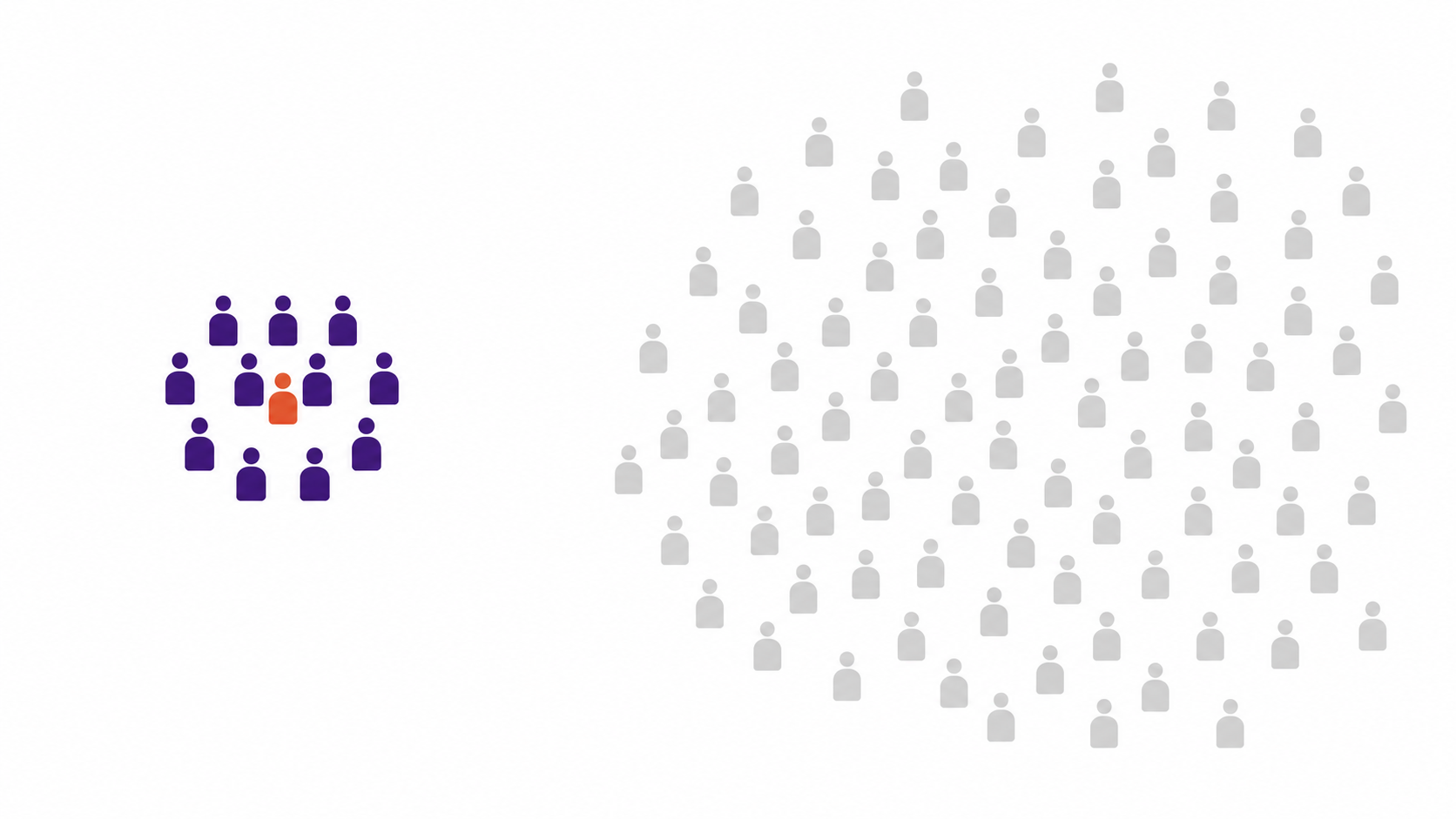
Your first 100 customers should not be a cross-section of everyone who might buy. They should be the narrow group who would be genuinely disappointed if the product disappeared, because that group shows you who to build for and becomes the template every later customer is matched against.
Superhuman, the email app, found its early customers by deliberately ignoring most of its users. Its founder Rahul Vohra surveyed users who had used the product at least twice in the previous two weeks and asked how they would feel if they could no longer use it. Only 22% said they would be very disappointed, well short of the 40% that growth marketer Sean Ellis found separates products that grow from products that struggle.
Vohra then set aside everyone who was not very disappointed, which is the step most founders skip. As First Round Review documents in its account of how Superhuman narrowed its early users, he looked closely at the people who were left. They were mostly founders, managers, executives and business development people, and focusing on that group alone lifted the score to 33%.
He then built the target customer from how that group described the people who would benefit most, in their own words. That description became the brief for who Superhuman went after next. Vohra borrows Paul Graham's advice here: an early company is better off with a small group who want the product a lot than a large group who want it a little.
The mechanism travels well beyond software, because the people who would miss you most share something, and that shared trait is what you go looking for in customer 101 and customer 1,001.
The first hundred are not a headcount. They are the template for every lookalike that follows.
Mamaearth launched in 2016 as a baby care brand, built for new parents who were reading ingredient labels and not liking what they found. That was a sharp choice of first customer, and it decided where the brand went looking for its first buyers.
The founders' consumer surveys showed that word of mouth was unusually strong in baby care, and that new mothers trusted other new mothers more than any advertisement. So instead of leading with a campaign, Mamaearth went to the places where those conversations were already happening.
Ghazal Alagh has described how she made friends with the mom bloggers of the time, before Instagram had become the default channel, and found that new mothers understood what she was building without much explanation. Alongside that came product sampling, on her reasoning that the cheapest way to market a product is to let customers experience it.
Paid acquisition was part of the picture too, and Alagh is open that much of the early funding went into acquiring customers in the first few months. But the customer had been chosen before the spend began, and the first channels were the ones that customer already trusted.
The design came first, and the routes to that customer followed directly from it.
The first 100 customers usually come through controlled distribution: the founder's networks, partnerships with businesses that already serve the customer, communities where the customer already gathers, and early adopters who go looking for new products. Each route brings in people you chose, which is what makes their behaviour worth reading.
Kamath is also clear that a strong bull market and digital onboarding helped Zerodha, so referrals were not the only tailwind. The point is narrower than that: every customer who arrives through these four routes is someone the founder can name, reach again and learn from, which no ad platform can promise in the first hundred.
Paid ads at the start put the product in front of whoever responds to an ad, not the customer you designed. The result is a mix of people with different reasons for buying, and that mix makes it very hard to separate real demand from noise at the stage when a founder most needs to.
Picture the first month of a launch run on paid social, where five hundred people buy. Some came for the discount, some because the creative was funny, some because the targeting caught them on a slow evening, and a handful because the product solved a real problem for them. The dashboard shows five hundred customers, but it cannot show which twenty of them matter.
A founder who brought in the first hundred through networks, partnerships and communities knows where each one came from and roughly why they bought. That is the difference between volume and clarity, and with your first 100 customers, clarity is worth more.
This is not an argument against paid ads. It is an argument about when they start working. Ads are a targeting tool, and targeting only works once you know who the target is.
After the first hundred have shown you the real customer, paid media has something precise to aim at, and every rupee spent on it goes further.
Controlled distribution first. Paid media second, aimed at the customer it revealed.
Your first 100 customers should be judged by what they reveal, not by how quickly the number was reached. Repeat behaviour, referrals, the words customers use and the routes they came through tell a founder who the real customer is, and that reading becomes the brief for everything the GTM scales next.
Most founders track the first hundred as a milestone to announce. We would track five things instead:
Together, these five readings produce something more useful than a growth curve: a description of the customer specific enough that a team could go out and find a thousand more. That is the point at which a founder is ready to build the system that keeps a GTM running after launch.
Your first 100 customers are not about volume. They are about clarity, and that clarity becomes the foundation of the whole GTM.
The hardest part of customer design is that founders are rarely the right people to do it objectively. They are too close to the product, too hopeful about the market, and too stretched by launch week to start turning customers away.
That is where The Cofoundry comes in, as the partner who sits beside the founder through the first 100 customers and asks the questions a founder is too close to ask.
The immediate work is designing the first customer with the founder, mapping the networks, partnerships and communities that reach them, and reading what the first hundred reveal as they arrive.
The larger build follows from that reading: a GTM that runs as an operating system, a clear call on which channels earn paid budget and when, and pricing set for the customer the first hundred revealed. It also means making sure growth does not depend on the founder carrying every decision alone.
Your co-founder in everything but the equity.
Through controlled distribution: the founder's networks and referrals, partnerships with businesses that already serve the customer, communities where the customer already talks about the problem, and early adopters who seek out new products. These routes are slower than ads at scale, but they bring in customers the founder chose, which makes their behaviour far easier to learn from.
Paid advertising works best once the first customers have shown a founder who the real customer is. Ads are a targeting tool, and they need a clear lookalike to aim at. Before that point, ad spend mostly buys a mix of customers with different motives, which hides the signal the founder needs.
Customer design is the founder's decision about who the business is for before demand is tested. It covers who the customer is, where they already spend time and who they trust, and why they would buy. It also means deciding who the business is not for, which is what makes the customer recognisable and easy to find again.
Founders should measure what the first 100 customers reveal rather than how quickly they arrived: who returns without a prompt, who refers others, the exact words customers use to describe the problem, which route each customer came through, and which customers are a poor fit. Together, these produce a description of the core customer that the rest of the GTM can scale.
Yes, and in B2B it is often the default, because early buyers want to deal with the founder directly. The routes change shape, with industry networks, referral partners and peer communities replacing consumer groups. The logic stays the same: design the customer, reach them through channels they already trust, and read what the first accounts reveal before scaling sales and marketing.