.svg)



A co-founder is not a second pair of hands. They are a second lens on every decision the business makes. The agencies we see stall rarely lack skill, ambition, or even clients. They lack someone in the room whose job is to see what the founder cannot.
We were asked this directly in a recent reel, and the answer had nothing to do with finding the perfect business partner or dividing the org chart in two. It was about a function that most solo founder agency builders try to perform for themselves, and the returns on that effort diminish every year the agency grows.
The question is not whether you are talented enough to build alone. The question is whether the agency you are building can survive having only one perspective at the top, compounding unchecked, for year after year.
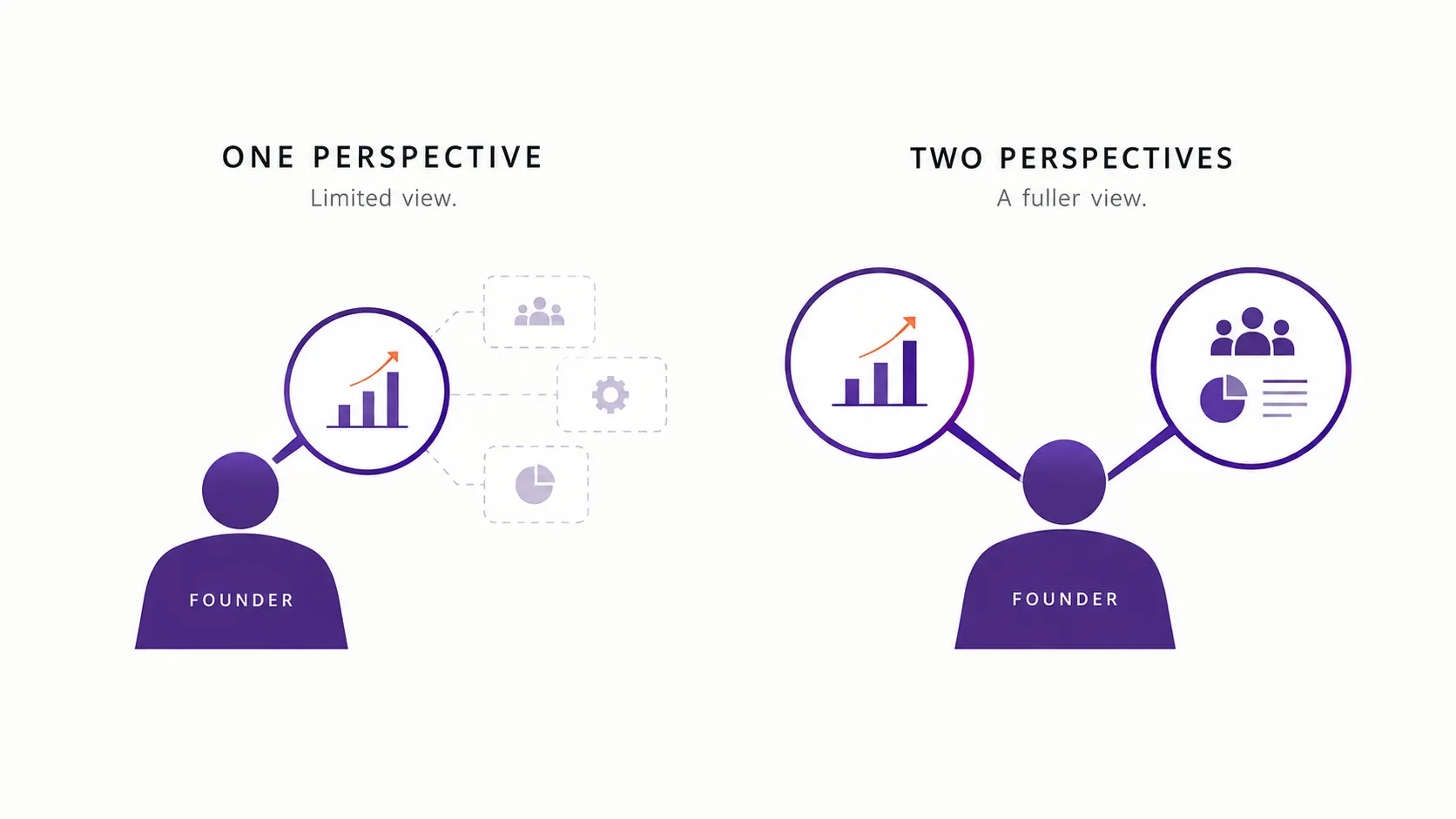
Most founders think their biggest constraint is clients or talent. It is neither. It is founder isolation. When every decision, every pressure point, and every blind spot sits on one brain, that brain becomes the ceiling. Not because it lacks capacity, but because one perspective is, by definition, one perspective.
The pattern repeats across the agencies we work with. A founder who is sharp on creative instinct under-invests in commercial structure. A founder who is sharp on margins under-invests in the kind of work that attracts better clients. The lens that built the agency becomes the lens that limits it, and there is nobody in the room whose standing lets them say so.
Every solo founder absorbs a set of costs that never appear on a P&L. They show up years later, in the shape of the agency, the clients it keeps, and the ceiling it hits.
Blind spots compound. A founder wired for creative quality builds an agency that wins awards and bleeds margin. A founder wired for commercial efficiency builds an agency that holds margin and churns talent. Neither lens is wrong. Both are incomplete.
A co-founder with the opposite wiring is not a disagreement waiting to happen. They are the half of the picture you cannot see from where you stand.
Pressure concentrates instead of distributing. Agencies run on human capital, which means more clients lead to more people, bigger teams, and more decisions per day. A solo founder absorbs all of that through one nervous system. The failure is not a breakdown. It is a narrowing of judgement over time, where you start saying yes to the wrong work because you no longer have the capacity to think clearly about the right work.
A retainer arrives from a client who pays well and never argues about scope. The work is dull and the team will hate it, but the revenue is clean. With a co-founder in the room, someone asks whether clean revenue is worth the creative attrition. Without one, the founder takes the retainer, because they are tired, the quarter needs it, and there is nobody to point out what it will cost six months from now when two good people leave.
The business is a single point of failure. If every significant decision, every difficult client conversation, and every strategic call still routes through one person, the agency has the same structure as a freelance practice with a payroll attached. One illness, one month of poor calls, one extended absence, and the business does not drift. It stops.
The founder knows this, which is why they rarely take a real holiday, rarely step back from a client relationship, and rarely test whether the agency can function without them. The test feels too dangerous to run, which is itself the proof that it needs to be run.
These costs never arrive as a crisis. They arrive as a shape, an agency that looks successful to clients and feels like a ceiling to the founder who built it.
A founder who agrees with themselves on every call is not decisive. They are unchallenged. The best decisions inside an agency come from two people who see the same problem differently and argue about it before the business commits.
A good co-founder sees your vision, but a great one challenges it. That friction is not a byproduct of the relationship. It is the point of it.
Kathleen Eisenhardt's research on how top management teams make better decisions through constructive conflict landed on a finding that agency founders should sit with. The alternative to conflict is not agreement. It is apathy and disengagement, which is where groupthink takes hold and the worst calls go unchallenged.
In an agency of fifteen people, the founder's thinking sets the ceiling for everyone below them. If nobody with equal stakes, equal context, and a different perspective ever pushes back, that thinking calcifies. The strategies that worked at one crore still run at five, not because they are right, but because nobody in the room has the standing to say they are not.
Consider what that looks like in practice. The founder who won the agency's first ten clients on the strength of their personal network keeps running the same referral playbook at fifty clients, even though the agency now has a brand, a body of work, and a positioning that should be doing the selling. Nobody on the team will say the playbook has outgrown its usefulness, because everyone on the team works for the person who wrote it.
A co-founder earns the standing to say it through skin in the game, not through title. They carry the same consequences, and that changes the quality of every conversation.
The difference between a co-founder and a senior hire is not competence. It is stakes. An employee fills a role you designed. A co-founder takes charge of an entire function, moves it forward, and makes calls without waiting for your direction.
Hiring solves a capability gap. A co-founder solves a structural one. The agency that brings on a talented creative director now has better creative output. The agency that brings on a co-founder who owns the creative function entirely, the hiring, the standards, the client conversations about what good looks like, now has a second centre of gravity.
This is where most founders get stuck when they try to solve the problem with a strong hire instead. A talented business head or creative director clears the calendar for about six weeks, and then the same ceiling reappears one level higher. The new hire is excellent at executing. They are still waiting for you to decide.
A co-founder does not wait. They own a dimension of the business, whether that is client relationships, delivery, or growth, and they run it with the weight of someone whose own future depends on the outcome.
We have talked about what happens when this dynamic goes wrong between co-founders, when the decision rights are unclear and productive friction turns personal. This is the other side of that argument. When it works, the founder who carried every function alone finds space to think about the business at a level they have not reached in years.
An employee, no matter how talented, has a fundamentally different relationship with risk. They can leave. A co-founder cannot walk away from the consequences of a bad quarter the way a hired executive can, and that difference shapes every call they make under pressure.
Not every agency founder will find a co-founder, and the argument is not that you must find one or fail. What you need is the function a co-founder performs, built into how the agency operates rather than depending on a single relationship.
Researchers at Harvard Business School studied solo founders who scaled successfully and found they did it by building what the study calls "co-creators" around them, people and organisations that provide the same challenge, perspective, and shared weight without the equity.
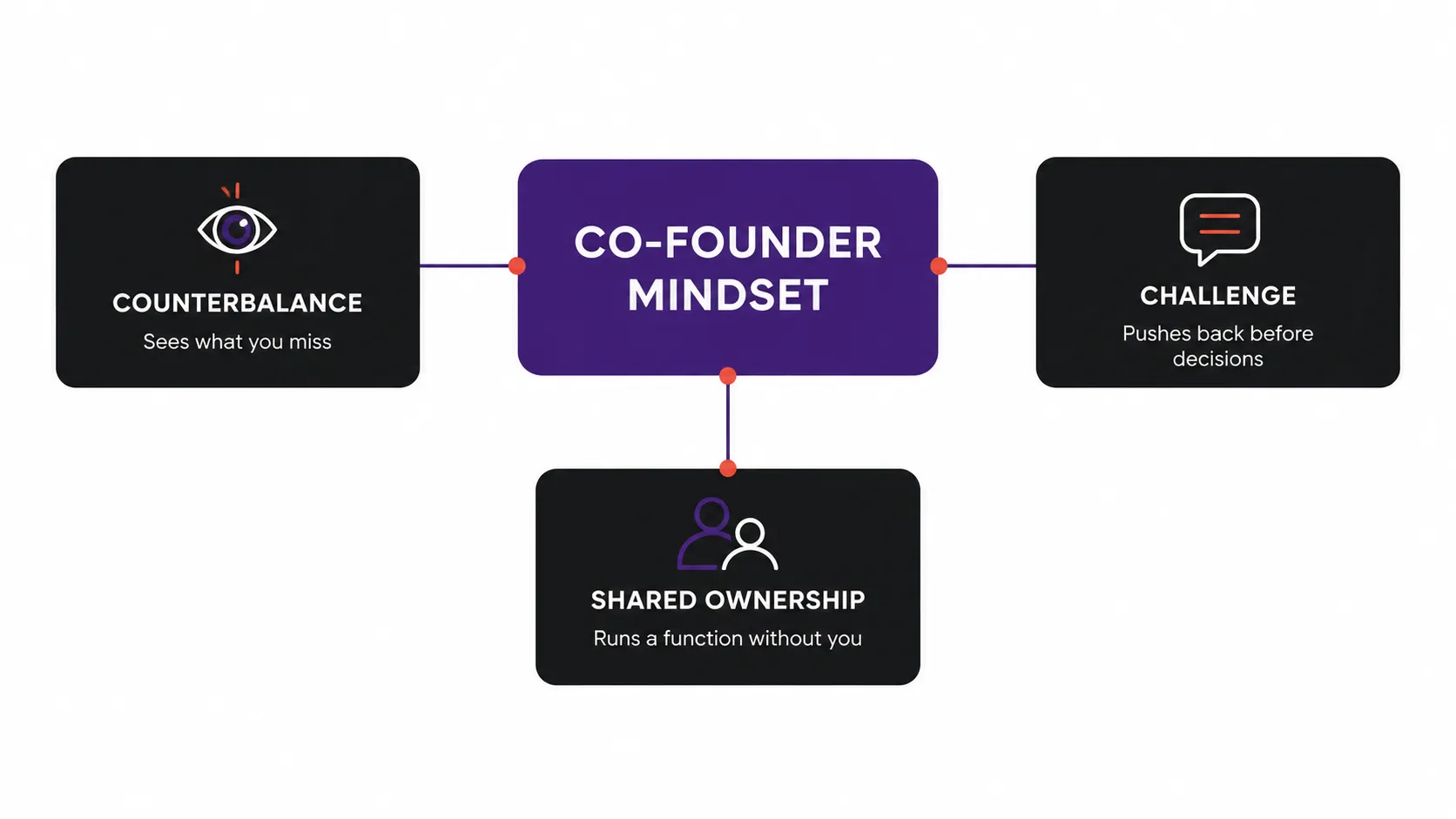
The co-founder mindset is not about finding a person. It is about building three functions into the agency's structure:
Building this is not a hiring decision. It is a design decision. It means giving a senior person a mandate that includes the right to disagree with you in front of the team, not just in private. It means writing down which calls they can make without you, and then actually staying out of those calls. It means reviewing their decisions after the fact, not before, which is the part most founders find hardest, because the instinct is to catch mistakes before they land rather than trust someone else to land them correctly.
Most solo founder agencies have none of this designed into their operating model. They have a team that executes and a founder who decides. That is not a co-founder mindset. It is a bottleneck with a payroll.
This is the gap we were built to fill. Not as an advisor who sees the business in quarterly snapshots. Not as a consultant who delivers a deck and leaves. As an operating partner who sits inside the agency's decision-making with the same weight a co-founder would carry.
We work with agency founders who built something real and then hit the ceiling that every solo founder eventually reaches, where the business cannot grow past the founder's own capacity to think, decide, and absorb pressure alone. The work starts with building the counterbalance, shared ownership, and challenge that the founder never had.
For some founders, that means embedding someone who carries an entire dimension, creative strategy while the founder holds the commercial side, or growth while the founder holds delivery. For others, it starts with restructuring decision rights so the founder is no longer the only person who can approve a pitch, a hire, or a pricing change.
It extends into team architecture, pricing, removing the founder from the functions they should have left behind two years ago, and designing the operating structure that lets the agency scale without scaling the founder's hours.
For founders who already have a co-founder and are navigating the friction that comes with shared ownership, we have talked about that directly. For the ones building alone, the answer is not to keep building alone and hope the ceiling lifts on its own.
Your co-founder in everything but the equity.
Agency founders need a co-founder because building alone creates compounding costs that never appear on a balance sheet. Blind spots go unchallenged, pressure concentrates on one person, decision quality degrades without debate, and the business remains a single point of failure. A co-founder provides counterbalance, shared ownership, and the productive friction that keeps strategy grounded.
The difference is stakes, not competence. A senior hire fills a role you defined and executes within it. A co-founder owns an entire function of the business, makes decisions without waiting for direction, and carries the same consequences as the founder when those decisions play out.
A solo founder can scale an agency, but only by building the co-founder mindset into the operating structure. That means designing counterbalance, challenge, and distributed ownership into how the agency runs, through senior people with genuine decision rights and a standing obligation to push back on the founder's thinking before it becomes strategy.
The co-founder mindset is not about finding a specific person. It is about building three functions into the agency's structure: counterbalance (someone who sees what the founder misses), challenge (someone who disagrees before the business commits), and shared ownership (someone who runs an entire function without routing decisions back through the founder).
The Cofoundry works as an operating partner embedded inside the agency's decision-making, carrying the same weight a co-founder would. The work covers team architecture, pricing, removing the founder from day-to-day functions, and building the operating structure that lets the agency grow beyond the founder's personal capacity.


.svg)

.svg)
.svg)


