.svg)




One service, one measurable outcome, and a fee that only pays in full when the client wins. Building an agency from scratch in 2026 is not a question of how many services you can list. It is a question of how quickly a stranger can verify that you are genuinely good at one of them.
Every agency founder has run this thought experiment at least once. The clients disappear overnight, the team goes with them, the name on the door stops meaning anything to anyone, and you start again on Monday with nothing.
We answered that question in a recent video, and the answer was shorter than most people expect.
Not a wider service list or a sharper pitch deck, but one service that solves a real business problem, priced so that we only win when the client wins, and designed from the first day to work through partners rather than departments.
Most new agencies do the opposite of all three. They open with a menu, because a menu looks like capability. They price on effort, because effort is easy to invoice. They hire to fill gaps, because hiring feels like progress.
Each of those choices is defensible on its own. Together they are the reason the first two years cost far more than they should.
A full-service offer costs a new agency the only two assets it actually has, which are focus and proof. Say yes to everything and you deliver each thing adequately, price each thing defensively, and finish the first year with a list of accounts rather than a result anyone can repeat back to you.
The instinct behind the menu is sound. You are new, the pipeline is thin, and turning work away when you have no revenue feels like a luxury reserved for agencies that already made it.
So the first four clients arrive across four disciplines. One wants social, one wants a website, one wants performance media, one wants a brand identity. Each is delivered competently, and none of them teaches you anything the next one can use.
That is the real cost, and it is not the money. Nothing you learn on the first brief makes the fifth one cheaper, because you rebuilt the process from scratch every time.
The second cost is quieter and it arrives in year two. Word of mouth needs a sentence to travel in, and "they are good at a lot of things" is not a sentence anyone repeats. "They rebuilt our retention emails and our repeat revenue moved inside a quarter" is.
A generalist agency with no track record has only two ways left to win a room. Be cheaper than everyone in it, or claim to be everything to everyone. Akshay has been blunt about where that ends, describing an industry where young founders struggle to drive real business outcomes and the market settles into undercutting costs.
Price is the only lever left when you have not given the client a reason to believe anything else about you.
The first real decision in building an agency from scratch is which service to lead with, and it is where most founders reach for the wrong criterion. They pick the thing they enjoy most, the thing they can staff most cheaply, or the thing their last agency was known for.
The better question is narrower than the one most founders start with. Which service can you attach to a number the client already watches, and move fast enough that they notice before renewal.
Four tests, and the service has to pass all four.
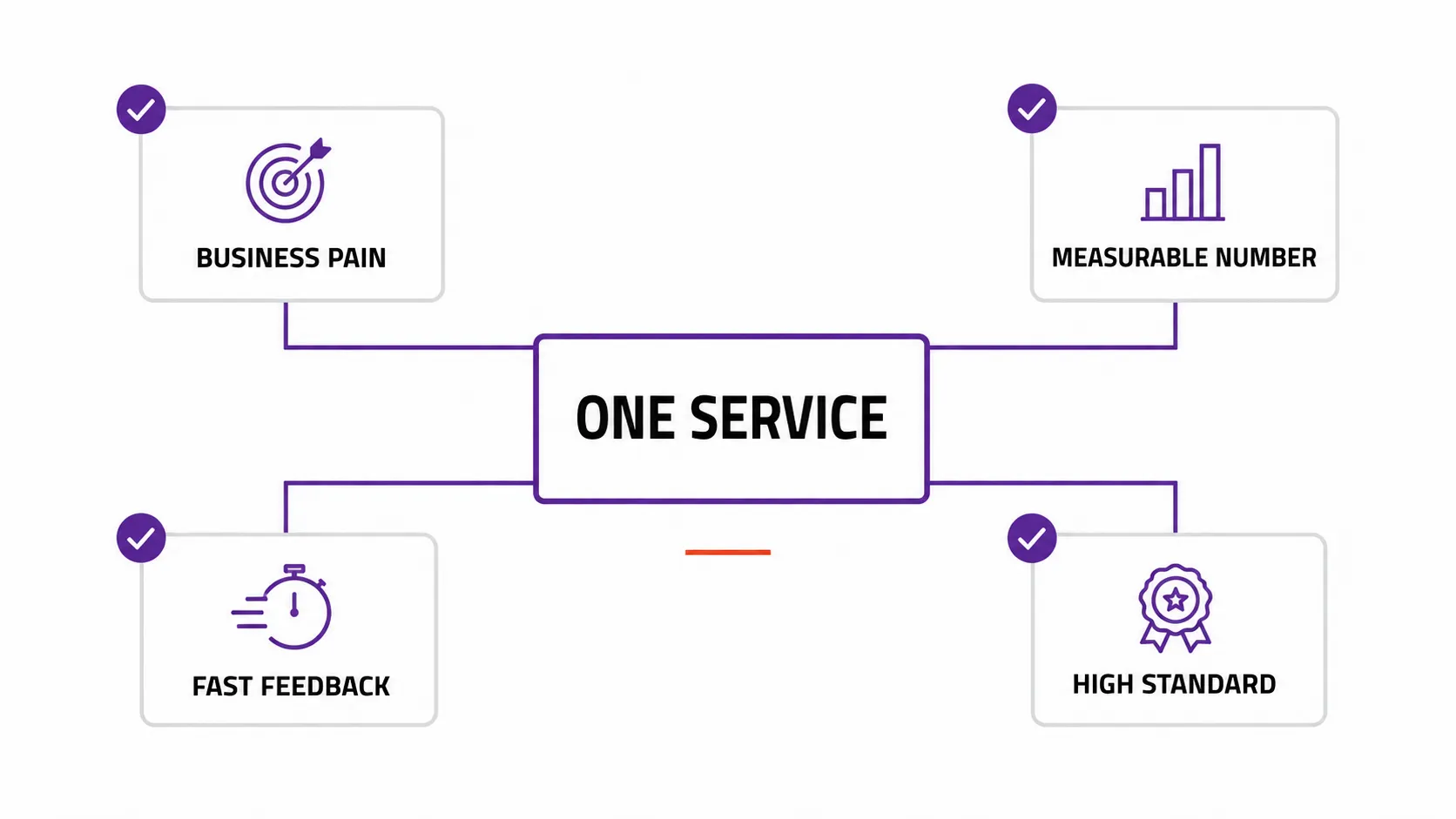
We have made the same argument about landing that first client: do not sell your service, solve a pain point, and concentrate on one or two niches rather than staying open to everything. D2C retention, creator-led marketing, user-generated content at volume. The specific niche matters much less than the fact that there is one.
Narrow is not a limitation you accept while you are small. It is the only thing that makes you legible to a stranger.
Both, inside the same contract. A base fee that covers the cost of doing the work properly, plus a component that pays out only when the client hits the number you were hired to move. For a founder with no track record, that structure is the fastest credibility available, and offering it costs nothing.
The instinct is to read outcome-linked pricing as a concession, something you offer because you have no leverage and a bigger agency never would.
Among large advertisers, the demand is running the other way. In a study of more than 80 multinational advertisers by the World Federation of Advertisers and MediaSense, 58% plan to buy more of their marketing on outcomes rather than on time and effort. Only 15% were doing it to spend less, and most expect their agency fees to rise over the next three years.
The client is not using outcome pricing to pay you less. They are using it to know what they are paying for, and they will pay more for that clarity.
The same study found that 87% of those advertisers believe agencies push back on any model that makes agency margins visible. That pushback is the opening for a new agency. An agency that has spent years building salaries and utilisation targets around a known margin has a real reason to resist, because pricing on outcomes exposes that margin and puts part of it at risk. A founder signing a first client has no margin to expose and no existing clients asking why they did not get the same deal. It costs nothing to offer, and it is the one thing an unknown agency can put on the table that a large one will hesitate over.
Outcome-linked pricing is not generosity, it is the only credibility instrument available to someone with no case studies.
Three guardrails keep it from becoming a trap.
They want one partner who holds the whole problem, which is not the same as one agency that staffs every discipline. Brands are tired of briefing five specialists who never speak to each other. What they are buying is coordination, and coordination is a habit long before it becomes a headcount.
This is the part founders get backwards most often. They hear that brands want an integrated partner and conclude they need creative, media, technology and production in-house, which is a decade of hiring and the quickest way to run out of money in year two.
Integration is a mindset before it is a service line. It means staying accountable for the whole outcome even where you are not doing the whole job.
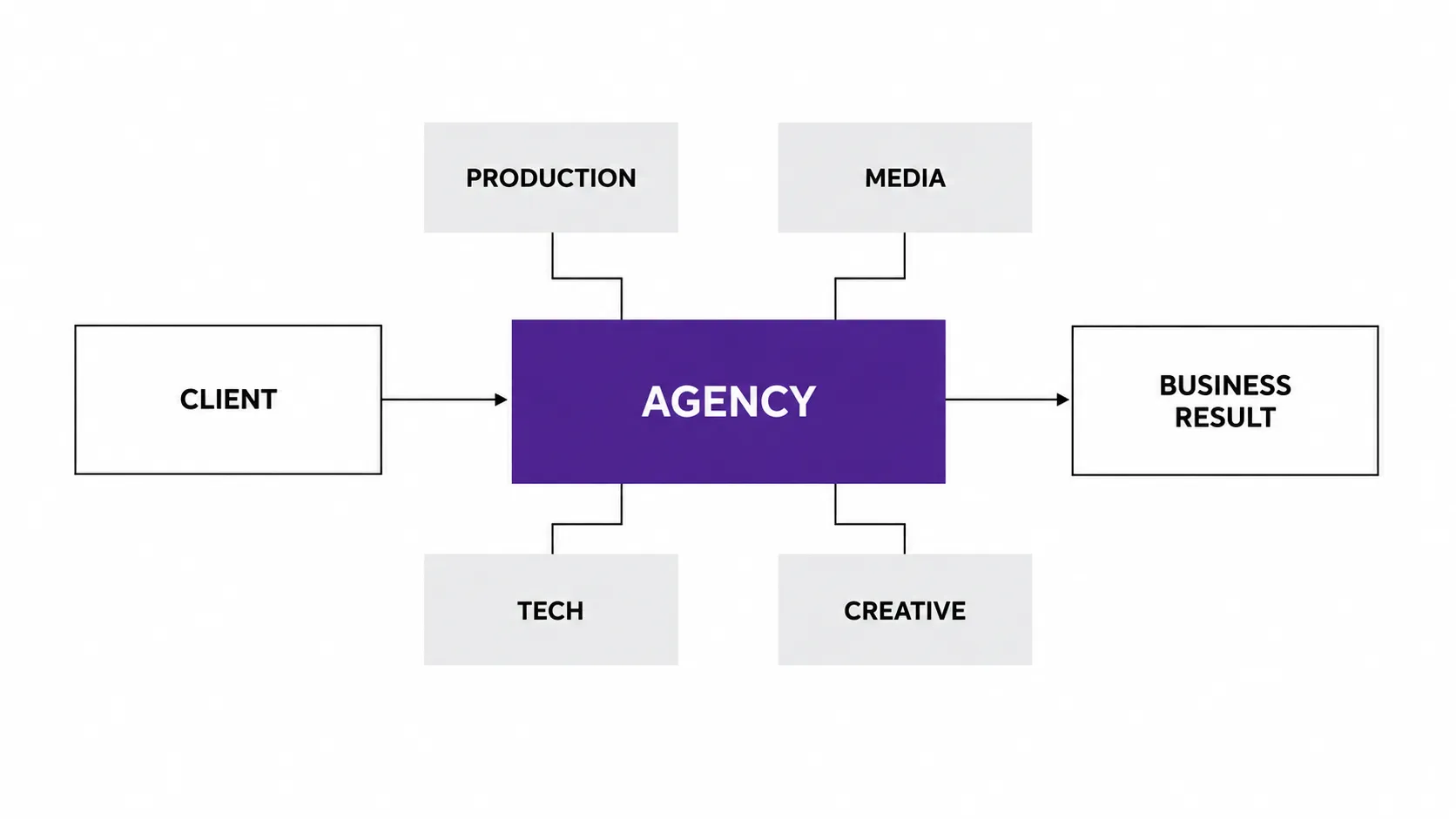
In practice that looks like a small bench of partners you have actually worked with, a production house, a media buyer, a developer, chosen before you need them and briefed by you rather than by the client. The brand gets one point of accountability. You stay the one holding the brief.
Across more than 300 brand partnerships, and a year spent consulting on the brand side, the pattern has been consistent. Brands do not want silos, they want a partner as invested in their growth as they are themselves.
This has to be settled on day one because it is very hard to retrofit. Once you have hired three specialists and built a P&L around keeping them busy, sending work to a partner reads as giving away revenue. Before those hires exist, it costs you nothing and it is simply how the agency works.
Codify it early enough and it stops being a decision. It becomes the way you are built.
The blueprint ends where most founders expect it to begin, which is with the number of logos on the website.
Chasing a hundred clients is the instinct of an agency measuring itself on revenue it has not earned yet. Solving one problem deeply is the instinct of an agency that understands what the first year is actually for.
Those early clients are not a revenue target. They are what every later client gets bought with.
Each one produces four assets, and only one of them is money. A result specific enough to state in a single sentence. Evidence of what the work is worth, which is how you price the next one without guessing. A delivery process you did not have before. And a person who will take a call from a stranger and vouch for you.
That last one is worth more than the fee. Referrals come from relationships that outlast the campaign, which is why the founders who compound fastest treat the client conversation as a standing habit rather than a reporting obligation. A quarterly conversation with no agenda and no deck, about what is genuinely keeping the founder awake, surfaces more real work than any pitch.
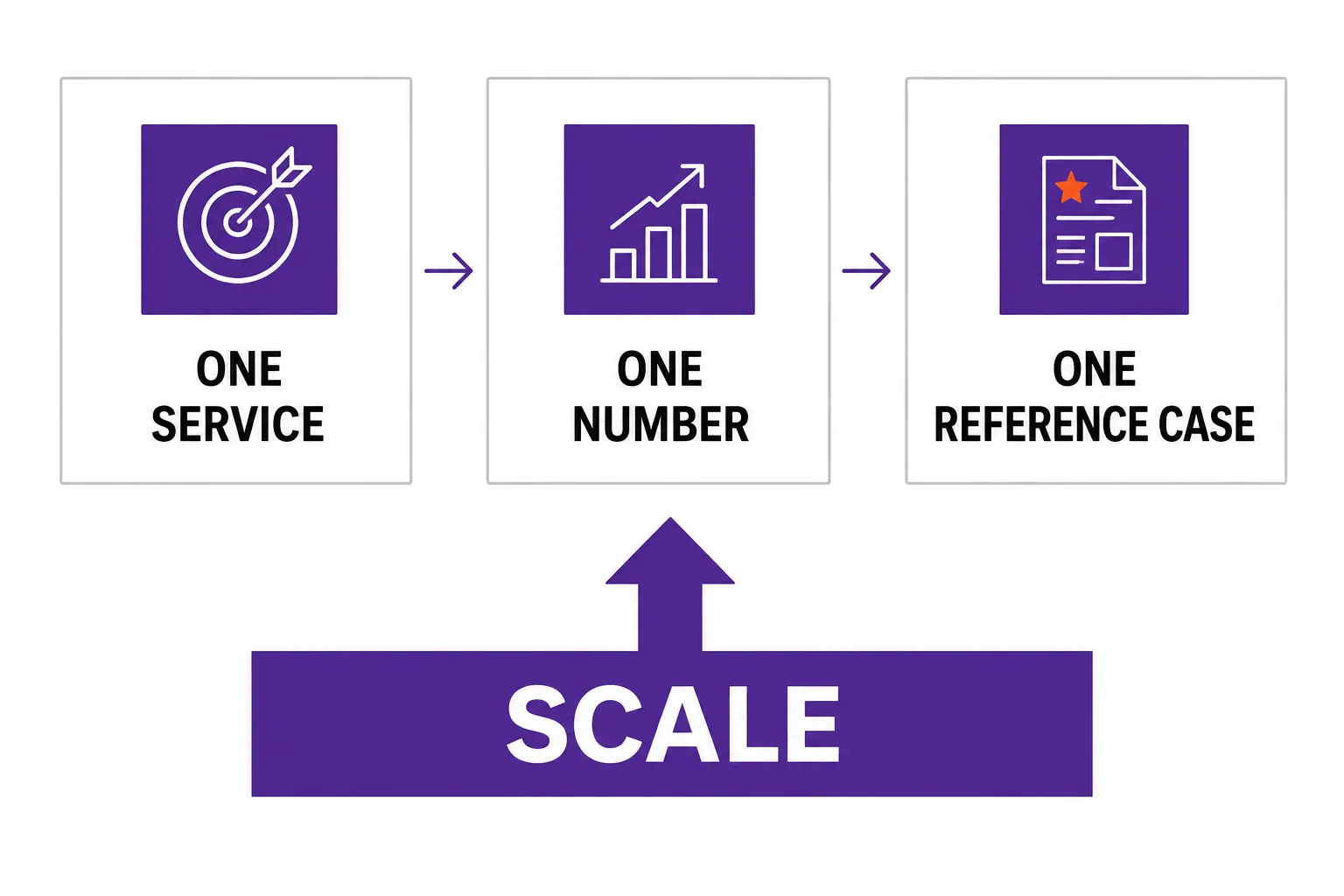
One service. One number. One reference case worth repeating.
Scale is what happens after that, and not a moment before.
Write down five things before the first contract exists: the one service you lead with, the number your fee attaches to, the partners you would call, the standard you will not drop, and the client you will turn away. Each one is far cheaper to decide now than to renegotiate in year two.
None of these takes more than an afternoon. All of them get harder the moment there is revenue attached to doing it the other way.
Most founders can see all of this from where they stand. Very few build it, because building it means designing the agency at exactly the moment when every available hour feels like it should go into finding the next client.
That is where we come in.
The Cofoundry works alongside agency founders rather than advising from a distance. With founders building now, that means choosing the first service, structuring a fee a client will sign, and assembling the partner bench before it is needed. With founders who already built the wider version, it usually means the harder work of stripping back, deciding what to stop selling, and repricing what remains.
The larger part is always the architecture underneath. How the agency prices, what it turns down, how ownership gets distributed as the team outgrows the founder, and how decisions stop routing through one person.
Agencies do not scale on effort, they scale on design, and that design is cheapest to get right before there is anything to dismantle.
Starting from zero is not the disadvantage it looks like. It is the only moment when every one of these decisions is still free.
Start with one service you can prove rather than a menu you can sell. Choose it by whether you can attach it to a number the client already tracks and move that number inside a quarter. Price it as a base fee plus a component tied to the result, build a partner bench instead of hiring every discipline, and treat the first handful of clients as the proof that buys every later one.
The one you can demonstrate fastest, not the one you enjoy most or can staff most cheaply. It should solve a business pain rather than fulfil a deliverable request, map to a metric already sitting on the client's dashboard, and have a feedback loop short enough to show movement within a quarter. Slower, more valuable work like brand strategy becomes much easier to sell once you have proved something measurable first.
Usually yes, provided it is structured as a base fee plus an outcome component rather than pure performance pricing. For a founder with no case studies, putting part of the fee at risk is the fastest way to make a stranger believe the work will land. The two things that keep it safe are attaching the fee to a metric your work genuinely influences, and agreeing how it will be measured before the work starts rather than after.
By being the single point of accountability without being the single supplier. Brands want one partner who holds the whole problem, which is a coordination habit rather than a headcount question. A small agency that leads the brief and brings in trusted production, media or technology partners delivers the same integrated experience without carrying the payroll of five departments.
Fewer than most founders assume when they start. The first year is not a revenue race, it is where you generate the proof, the pricing evidence, the delivery process and the referral relationships that everything after year one gets built on. A small number of clients solved deeply produces all four. A long list of accounts served adequately produces none of them.


.svg)

.svg)
.svg)


