.svg)




The freelancer to agency switch is triggered by inbound work you cannot hold, not by a revenue number you have crossed. When good briefs start going elsewhere because your calendar is full, the constraint has already moved from demand to capacity, and working harder will not move it back.
Most freelancers are waiting for a number. A monthly income that feels stable enough, a client count that looks like a business, or a quarter where nothing breaks. The number eventually arrives and nothing changes. It was never the thing holding them back in the first place.
We were asked this directly in a recent AMA, and the answer had nothing to do with revenue.
There is an inflection point in every independent career where the work stops being about me and starts being about we. It shows up as volume you cannot personally absorb, and it arrives on its own schedule rather than on the one you planned for.
Founders miss it because they are watching the wrong instruments. Revenue tells you the work is good. Client count tells you the network is working. Neither of them tells you that you have become the ceiling.
Freelancers say they will hire when they feel ready. The problem is that readiness is a judgement about work you have not done yet. You find out whether you can manage someone by managing someone, and you find out whether the business survives your absence by being absent.
The confidence you are waiting for only arrives on the other side of the decision, and the waiting is expensive in a way that never shows up on an invoice. Every month spent at capacity is a month of turned-down briefs, delayed rate increases, and relationships that quietly move to whoever answered first.
The freelancers who make this switch well are not braver than the ones who stall. They are looking at a different kind of evidence.
The evidence for the freelancer to agency move sits outside you, in the calendar, the inbox, and the list of things you said no to last quarter. All of it is observable, and acting on it does not require you to feel any particular way first.
The signals that matter are all external, and every one of them is visible in a calendar or an inbox. Inbound outstrips capacity, the work you decline is better than the work you accept, a rate rise does not dent demand, clients keep asking for adjacent work you route away, and a week off stops the revenue.
None of these is conclusive on its own. Three of them running together usually means the decision was made for you some time ago and you are still catching up.
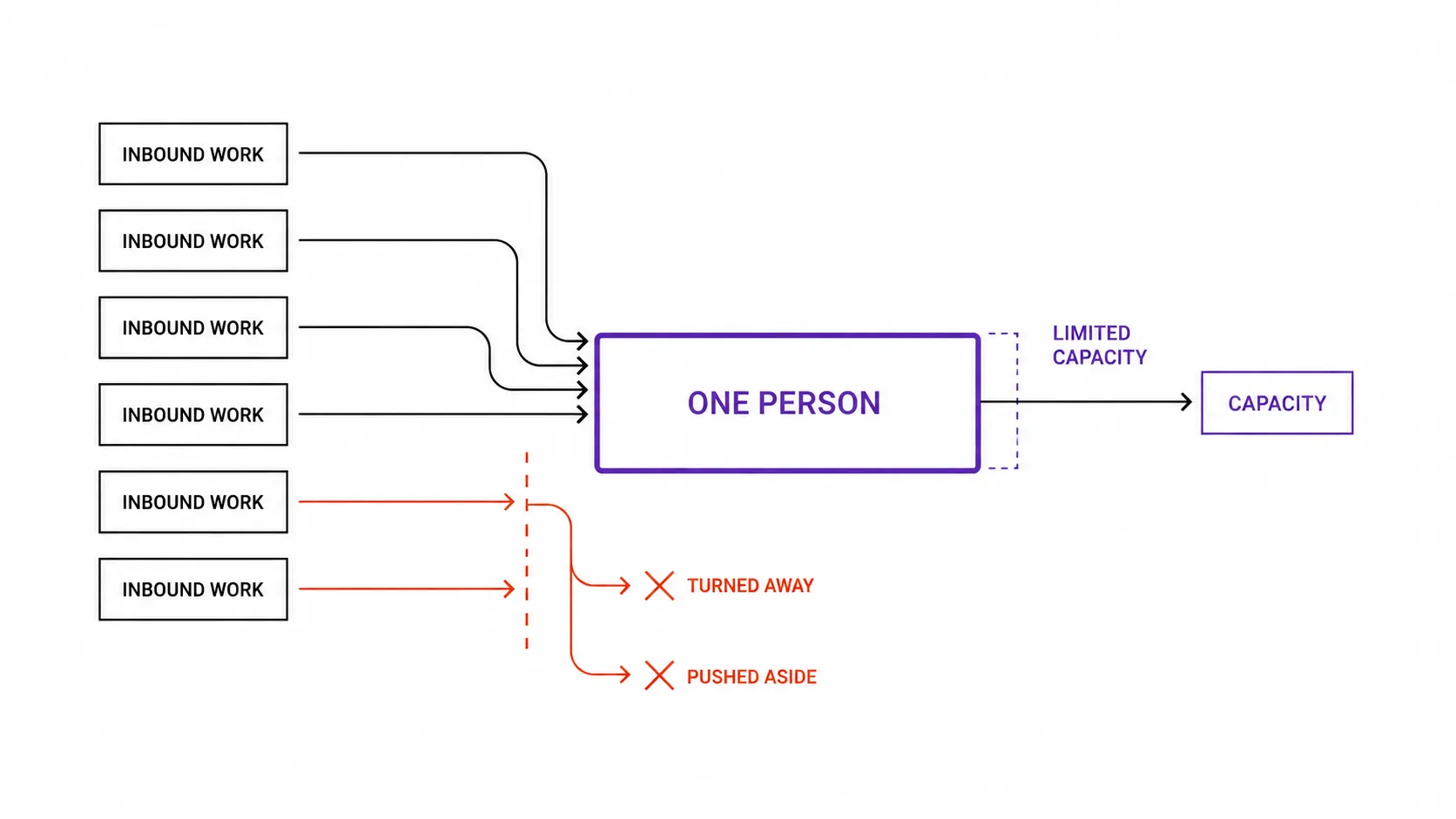
This is not a scorecard with a threshold that turns green. It is a description of a business that has outgrown the shape it was built in.
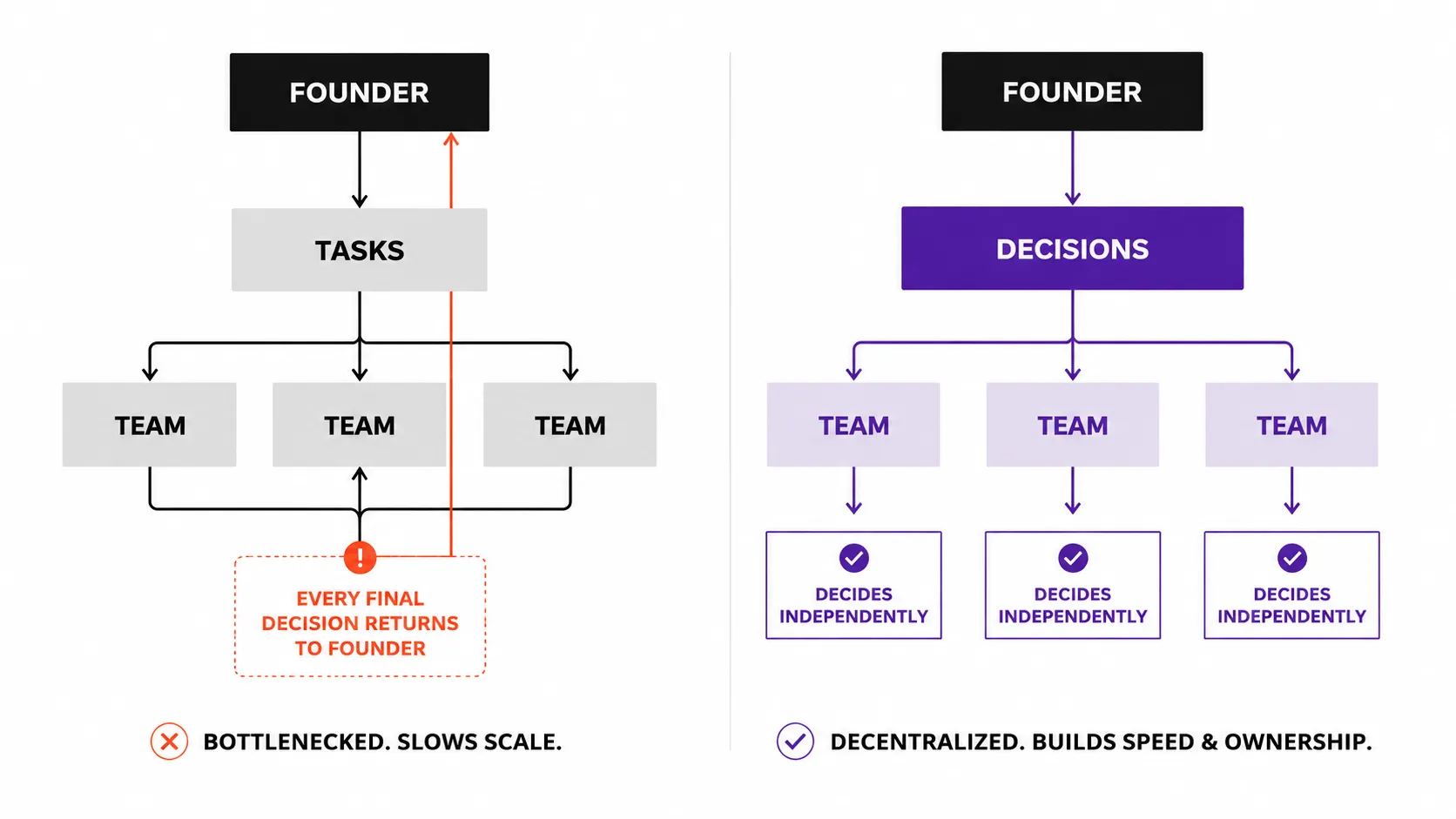
You are not handing over tasks. You are handing over judgement, which is the thing the client actually bought. That is why this transition is harder for freelancers than for founders who never delivered the work themselves, and why so many stall halfway, with a team that executes and a founder who still decides everything.
Delegation gets described as a workload problem, and that framing is exactly what makes it fail. Hand over tasks and you get an assistant, which relieves the calendar for about six weeks before the same ceiling reappears one level higher up.
The freelance business is built on a specific promise. The person who sold the work is the person who does the work, and the client is paying for that guarantee as much as for the output itself. Hiring breaks that promise in public, which is why the first hire feels less like growth and more like exposure.
We have made this point about the agency that reaches ₹1Cr and stalls there. At that stage the founder is the system. Every decision, every standard, every client relationship routes through one person, and the business grows exactly as fast as that person can process it.
A freelancer is the same structure at a smaller scale, which is useful to know, since it means the problem is already familiar rather than new. What changes at the switch is not how much work there is. It is who is allowed to make a call without you.
That is the real handover, and it is why this is a control decision long before it is a revenue one.
Because for most of your career, doing it yourself was the standard. The reputation you are trading on was built entirely on personal delivery, so passing work to someone else does not register as scaling. It registers as putting the only asset you own into a stranger's hands.
Founders treat that resistance as a discipline problem and try to beat it with willpower, which fails reliably, because the resistance is not a character flaw.
Elsbeth Johnson of MIT Sloan puts the difficulty somewhere less flattering. High achievers, in her framing, are effectively addicted to the dopamine of doing the work, and get almost none of that same satisfaction from overseeing it. She also points out that professional services make the habit worse, since the industry keeps rewarding the person who personally produces rather than the one who builds capability around themselves.
That description fits an experienced freelancer almost exactly. You built an income on being the best available version of yourself at one craft, and every year of doing it deepened the wiring.
Which means the discomfort is not a signal to wait longer. It is the predictable cost of changing the structure, and no amount of thinking about it in advance makes it fade.
What helps is replacing the instinct with a rule you do not renegotiate every time. Johnson's own fix is simple enough to write on a wall: before doing any task, ask who the best person is to do it to an acceptable standard, given what your hour is worth.
For a freelancer making this switch, we would add one condition, because "acceptable" is where the whole thing gets decided. Define the standard in writing before you hire. Otherwise acceptable will keep drifting upward until it means "the way I would have done it", and the work will be back on your desk inside a month.
Slightly better is the trap. It is the reason founders sit in the delivery seat for three years longer than the business ever needed them there.
Four things, and all of them are cheaper to decide now than to retrofit later: a written standard, a short list of what only you do, a rate that funds a second person, and one process documented while you are still the one running it.
Most freelancers hire in a panic, usually in the week after a deadline nearly slipped. The hire arrives into a business with nothing written down anywhere, learns the job by watching, and reproduces the founder's habits without the founder's judgement.
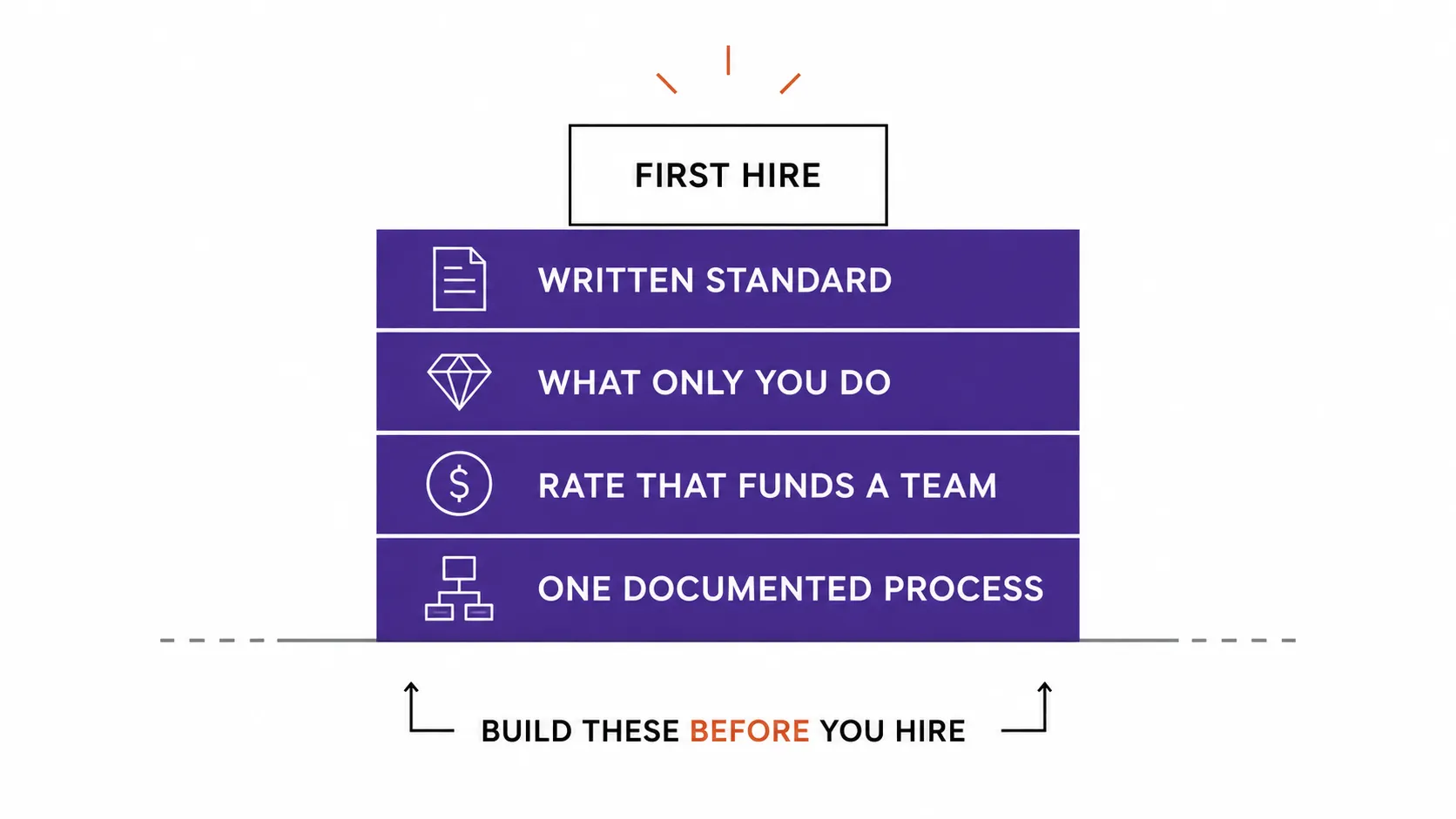
None of this takes more than a week. All of it gets considerably harder once there is a person on payroll waiting for direction.
Not every freelancer at capacity needs employees. A bench of trusted specialists you brief and stand behind buys you the same expanded capacity without payroll, and for a lot of independents that is the right answer for another two years. The difference between the two is who carries the risk.
The word agency does a lot of unhelpful work in the freelancer to agency conversation. It suggests an office, a payroll and a headcount target, which is a far larger commitment than most freelancers at capacity actually need to make.
A bench is the lighter of the two structures. Three or four specialists you have genuinely worked with, brought in under your name, on your brief, to your standard. The client deals with you throughout and you stay accountable for the whole outcome, which is the part they care about.
It works, and it has a real limit. A bench scales delivery without scaling you. The briefing, the quality check and the client relationship still route through one person, so the ceiling moves up rather than disappearing.
Employees are what you buy when you want someone else to be able to think about the account. That is a different purchase at a different cost, and it is worth being honest about which one the business needs right now.
Most independents should start with the bench and hire the moment the briefing itself becomes the bottleneck.
The move from freelancer to agency gets described as a growth decision, and that is the part most founders get backwards. Growth is the outcome. The decision is about how much of the business you are willing to stop touching.
Everyone who makes the move discovers the same thing in the first six months. The work comes back slightly different from how you would have done it, the client does not notice, and the business earns on a day you were not in the room. That is not a compromise to tolerate, it is the entire point of building the structure.
Very few founders design this deliberately, because the switch happens in the middle of the busiest year of a working life. The standard gets written after the first bad delivery, the pricing gets fixed after the first payroll shortfall, and the list of what only you do never gets written at all.
That is where we come in.
The Cofoundry works alongside founders rather than advising from a distance. For an independent making the switch now, that means setting the standard, repricing the offer so it carries more than one person, and deciding what leaves your hands first. For founders who already hired and found the ceiling waiting one level up, it is usually the harder work of taking decisions out of the founder's queue and putting them somewhere they can live without you.
The larger part is always the architecture underneath. How the business prices, what it turns down, how ownership gets distributed as the team grows, and how decisions stop routing through one person.
The me becomes a we on the day you stop being the only one allowed to decide.
Your co-founder in everything but the equity.
When inbound work consistently exceeds what you can personally deliver, and the pattern holds across a full quarter rather than a busy fortnight. The clearest confirmation is the list of briefs you turned down. If the better-paid, more interesting work is on that list because you had no capacity, the switch is already overdue. Revenue milestones and client counts are poor triggers, because both can look healthy while you are the constraint.
There is no universal number, and chasing one is how founders stay stuck. The more useful test is whether your current rate carries a second person's cost, including their salary, the hours you will spend managing them, and the gaps between projects. Most freelance pricing is built around one person's time and does not survive that arithmetic, which is why repricing should happen before the hire rather than after it.
Hire against the work that consumes the most of your hours at the lowest value, which for most independents is production or coordination rather than strategy. Before that, write down what good looks like and the three or four things only you will do. Hiring without a written standard almost always ends with the founder redoing the work quietly and concluding that the hire was a mistake.
By accepting that the discomfort is structural rather than a lapse in discipline. Elsbeth Johnson of MIT Sloan describes high achievers as effectively addicted to the satisfaction of doing the work themselves, a habit professional services actively reward. The practical fix is a rule you do not renegotiate: if someone else can do a task to a defined standard, the task is theirs, even when you would do it slightly better.
Yes, and for many the bench is the better structure. Three or four trusted specialists brought in under your name, on your brief, to your standard, gives you capacity without payroll while you stay the single point of accountability for the client. The limit is that a bench scales delivery and not you, because the briefing and the quality check still run through one person. When the briefing itself becomes the bottleneck, employees are the next move.


.svg)

.svg)



.svg)


