.svg)




Every specialist agency eventually hits the same wall. Clients love the work, then ask the question every agency now has to answer: how do you prove your ROI without turning into a media agency. Bridging that gap starts with a different promise, not a better report after the work ships.
A design and content studio once put the tension to us plainly. Clients loved the creative, and kept leaving anyway for performance agencies who could, in the client's words, prove results. We answered a version of this on video, and the question keeps resurfacing in different layers. An SEO agency watches a retainer move in-house because the internal growth team can show a keyword chart.
A PR firm places real coverage and gets no credit for it, while a performance agency claims the traffic bump that followed. A social team defends a content calendar against a media plan with a rupee figure stapled to it.
Strip away the channel and it is the same founder asking the same question: how do we bridge this gap without becoming a media agency ourselves. Most agencies should not want to. Learning attribution modelling, building a paid desk, or turning into the thing currently outcompeting you is not the fix. The fix does not live in the discipline you are missing. It lives in what you sell before a single deliverable ships.
Most agencies assume the ROI conversation happens in the results deck, once a campaign wraps. It does not. It happens the moment a proposal describes a stack of deliverables instead of a business result, and by then the client is already comparing you to someone selling a number.
Read a typical creative or content proposal and you will find the same sentence in different words: twenty statics and five reels a month, ten blog posts a quarter, twenty media placements a year. Every one of those lines describes effort, not impact. A performance agency across the table is not promising more effort. It is promising a lift in a number the client already tracks, and the client has no way to compare the two offers except to notice that only one of them sounds like growth.
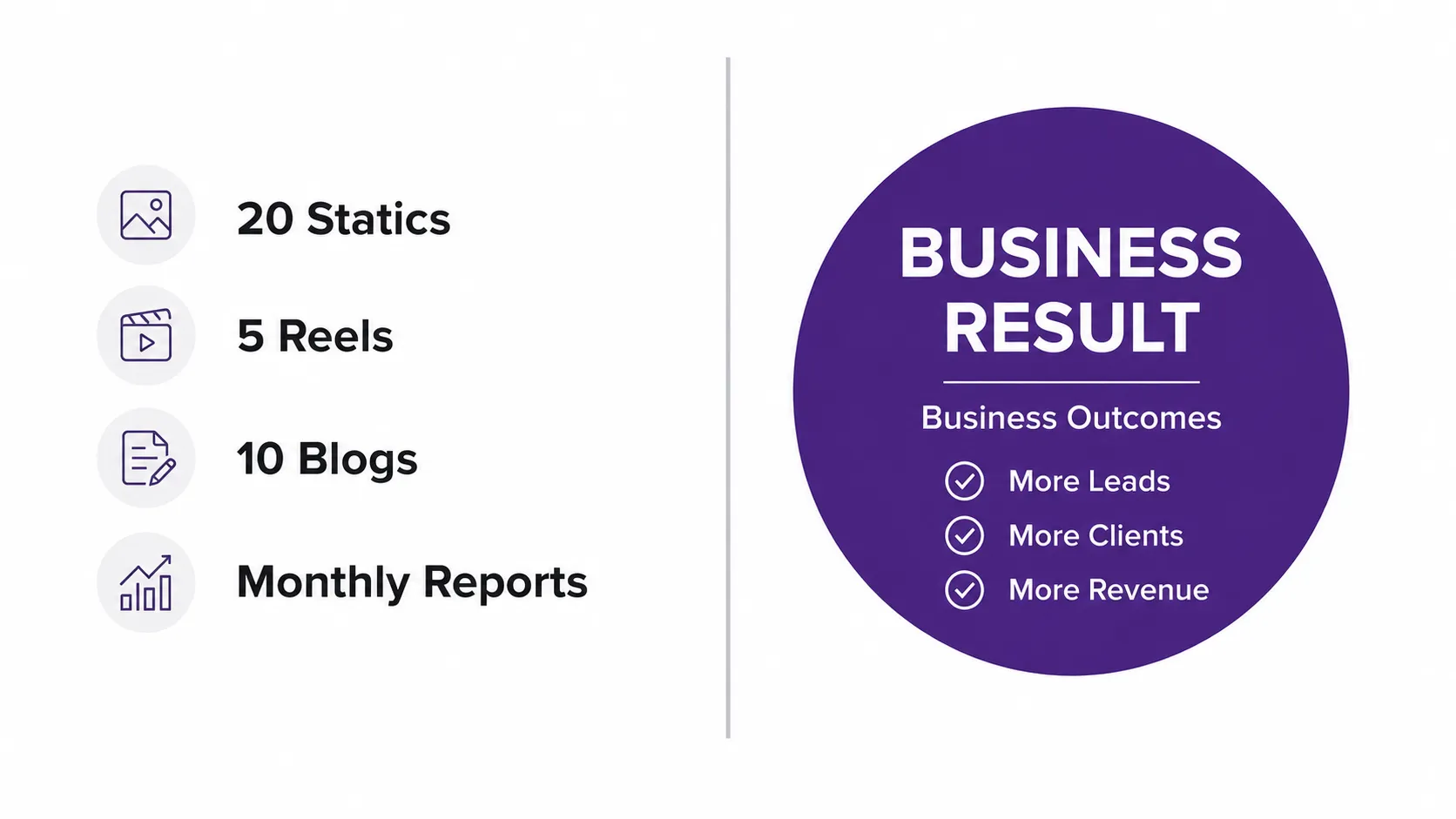
This pressure is not isolated to performance channels anymore. Marketing leaders now call proving ROI their single biggest priority, up from a much smaller share five years ago, and that scrutiny lands on every agency relationship a client holds, creative, PR, content, design, not just the ones running paid media. A studio that keeps selling by the deliverable is bringing a checklist to a conversation the client has already reframed around outcomes.
There are only three things any agency can price: the hours it puts in, the deliverables those hours produce, or the outcome those deliverables create.
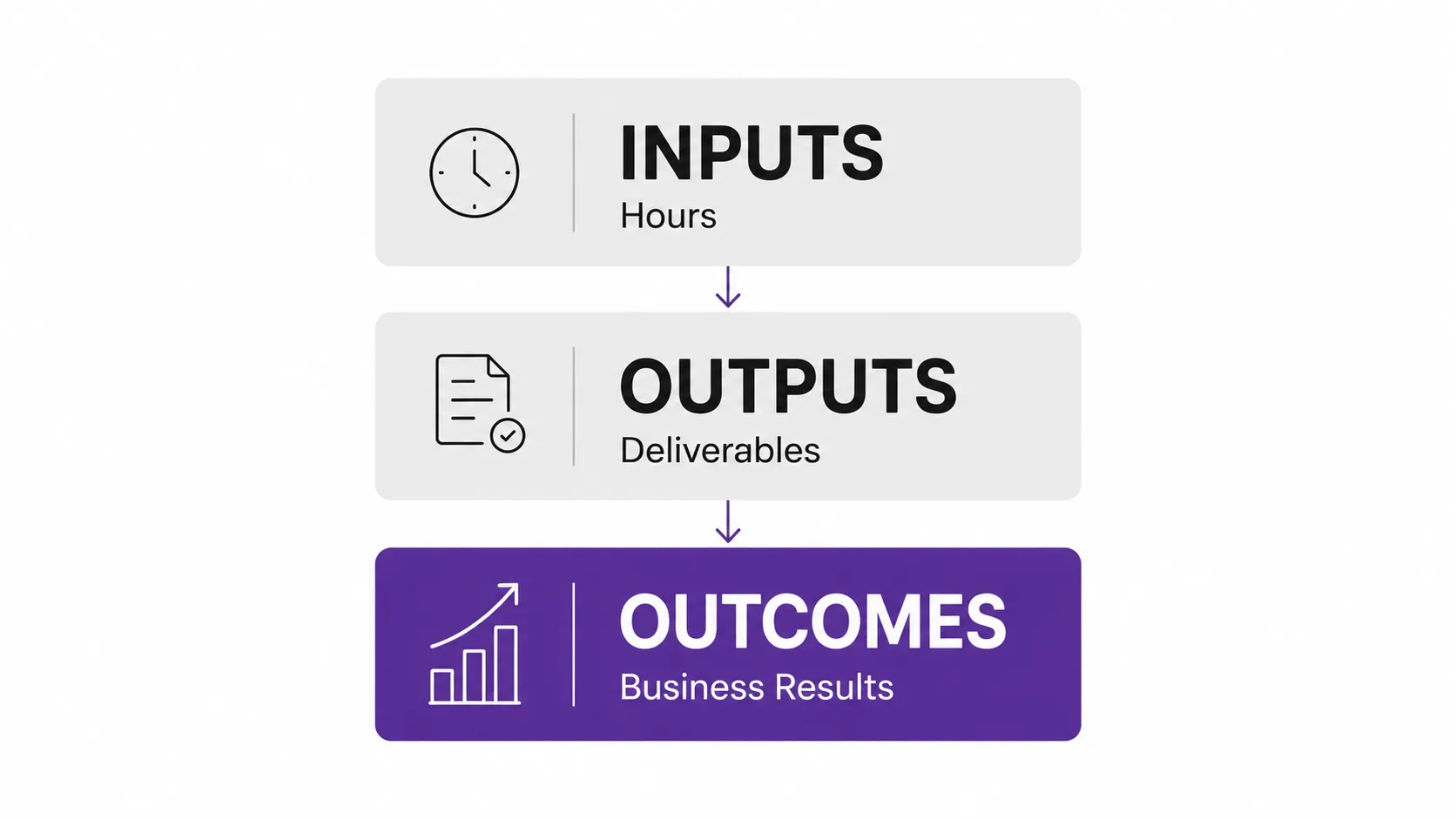
Selling the hour caps you at your own capacity, a day only has so many billable hours in it, and it invites the one argument almost every client eventually makes: that the job never needed that many hours to begin with. Once a fee is built on hours, a client has an easy opening to negotiate your process instead of your value. Selling the output, the reel count, the post count, the placement count, caps you even lower, because a client can always find someone willing to produce the same output for less.
Selling the outcome is the only one of the three that lets a client compare you to a performance agency on equal footing. "We'll increase your profile engagement by 30%, and here is what that has historically driven in site traffic for a brand at your stage" is not a bigger promise than "twenty statics and five reels." It is a different kind of promise, made in the same language the client already uses to judge every other line item in their marketing budget.
This is not a performance-marketing invention. Consulting and legal firms have priced against the value they create rather than the hours they log for years now, mostly because their clients stopped accepting an invoice that only itemised time. Value-based pricing reaches the agency world later than it should, not because agencies cannot do it, but because a deliverable is far easier to count than an outcome is to prove. Counting is not the same as proving, and clients have started noticing the difference.
Here is where most founders get the instruction backward. They hear "clients want to see business impact" and translate it into "we need to become a performance agency." That is the wrong read of the problem.
The skill is not becoming a media agency. It is learning to speak the client's language about impact, without taking on a discipline you were never built to run. A studio does not need a paid media licence to say "here is what our content historically does to your site traffic." It needs to have already measured that link once, kept the number, and be willing to lead with it in the next proposal instead of burying it in a quarterly report nobody reads until renewal season.
Once that shift happens, the studio is no longer being compared to the performance agency on the performance agency's terms. It is being judged as a partner making a business promise, the same category the client already puts every serious vendor into. Only if a client still insists on a hard, channel-level number the studio genuinely cannot produce does the account need a second discipline alongside the first, a real, separate decision worth making deliberately, not by default.
Rebuilding a proposal around outcomes is a smaller, more mechanical shift than most founders expect. In practice it comes down to four moves.
None of these four steps require a new hire, a new tool, or a new discipline. They require rewriting the sentence a founder is already saying in every pitch. What actually changes afterward is not the work itself, it is which conversation the client is having with you: not whether you can keep up with the output, but whether you are moving the number they care about.
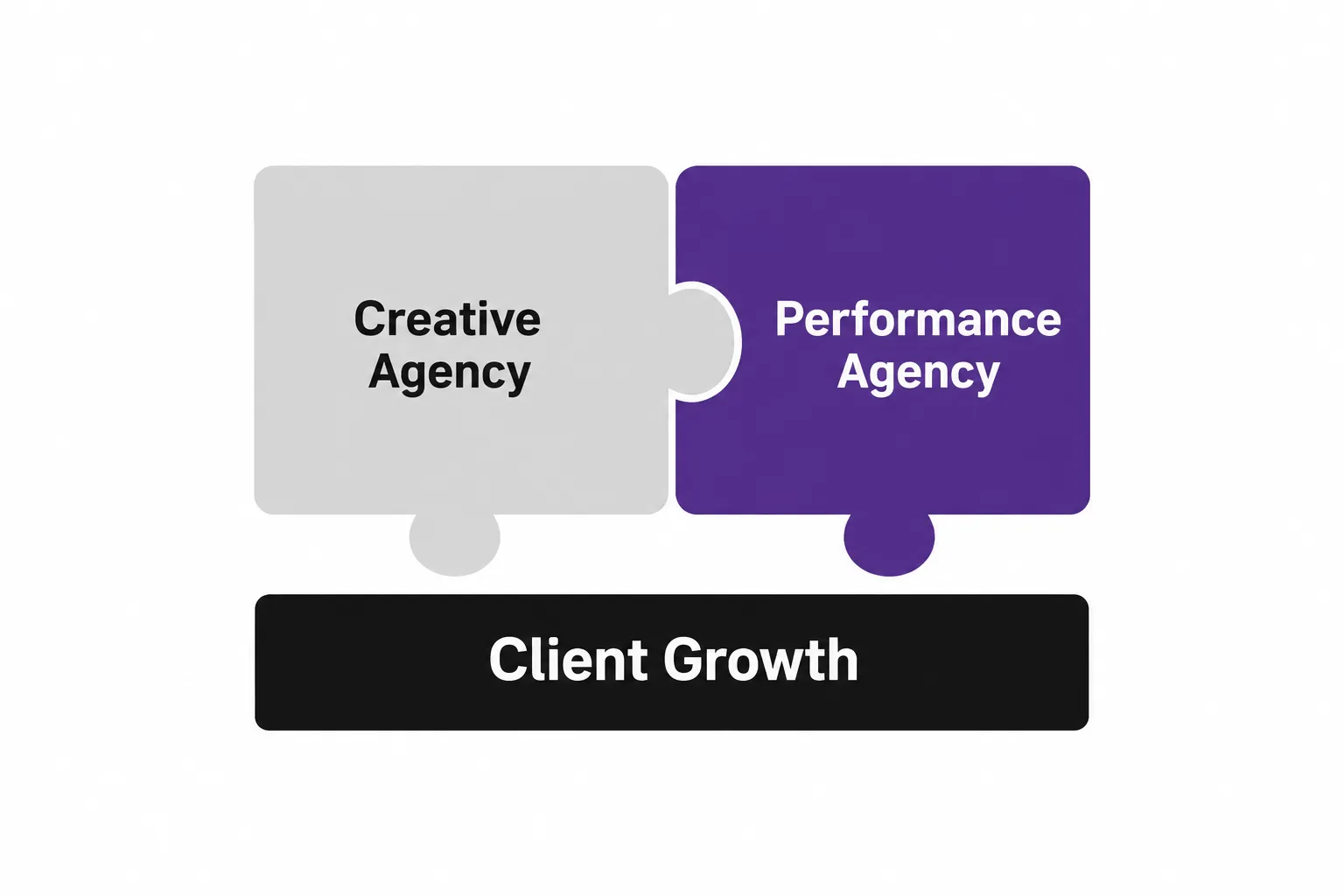
Even after a proposal leads with an outcome, some clients will still ask for a hard, channel-level number a specialist agency cannot produce on its own: attribution modelling, paid media optimisation, a live dashboard of spend against conversions. That request does not mean the repositioning failed. It means the account now needs a second discipline alongside the first.
The instinct most founders resist is bringing in another agency on the same account, because it looks like admitting the work needed help. Read the situation differently and the same move looks like something else entirely: a specialist choosing exactly which discipline to add, instead of losing the whole relationship to whoever the client finds first.
In practice, this usually takes one of two shapes. Either the specialist subcontracts the performance work and stays the client's single point of contact, billing that piece through its own invoice and keeping the relationship whole, or the two agencies split the account directly, each billing the client for their own scope and sharing credit for the combined result. The second shape needs a clear line on paper before the work starts: who owns which channel, who reports which number, and how credit gets divided when both pieces move the same metric together.
Positioned well, bringing in a partner is not a concession. It is the agency curating the right expertise for its client, the same instinct that earned its trust on the work in the first place. Framed that way to the client, the move reads as care rather than compromise, proof the agency is invested enough in the outcome to bring in the right specialist, instead of staying quiet about a gap to protect its own invoice. That is what a genuine partner does. A vendor guarding its turf does the opposite.
The relationship does not have to end with one client. An agency and a performance partner who work well together on one account tend to keep referring each other into the next one, each staying in the lane it does best. What starts as the fix for a single client's ROI question can become a standing partnership, one where both agencies earn more and both founders' networks grow.
Clients did not start asking creative agencies to prove impact because performance marketing got better at it. They started asking every vendor, because the budget got tighter and the scrutiny got even. The agencies losing accounts are not losing them to a better discipline. They are losing them to a better sentence.
AI sharpens this further. Clients now watch AI compress work that used to take a specialist days into an afternoon, and two expectations follow from that in the same breath. One, an agency should do more for the same fee, since the manual grind an hourly rate used to cover has quietly gotten cheaper. Two, whatever still costs real money needs to show what it changed in the business, because craft alone no longer explains the price. Proving impact was already becoming table stakes. AI just removed the last fallback most agencies had, that the work took real time and skill, and it removed it from every agency at once.
Fix the sentence, and the channel stops mattering. The studio that leads with an outcome is no longer defending its craft against someone else's numbers. It is finally speaking the one language every client in the room already understands.
By changing what gets promised before the work starts, not by adding a new discipline. Instead of pitching a count of deliverables, name the business metric the client already tracks and tie your work to it directly. The agency stays exactly what it is. Only the proposal changes.
Usually not because the work got worse. A performance agency arrives with a number attached to its offer, and a specialist agency pitching by the deliverable has nothing comparable to put next to it. The client is not comparing craft, it is comparing which offer sounds like a business result.
An output is what you produce, the reel, the post, the placement. An outcome is what that production does for the client's business, the engagement lift, the traffic it drives, the leads it generates. Selling the output caps your value at the cost of making more of it. Selling the outcome lets a client judge you the same way they judge every other line in their budget.
Not the entire engagement necessarily, but the pitch should lead with an outcome even where billing stays retainer-based. Tying even a portion of the fee to a result changes how a client reads the rest of the contract, and it is a pricing model professional services firms have used for years, well before the current creative-versus-performance debate.
When a client insists on a specific, channel-level number a specialist agency genuinely cannot produce, whether that is a live ad-spend dashboard or attribution across every touchpoint. At that point, splitting the account, keeping your own client relationship intact while a partner covers the piece you cannot, protects the account better than losing it outright or trying to build that capability from scratch. The partner worth choosing is one willing to own a slice of the client for years, not the whole client for one renewal cycle.


.svg)

.svg)
.svg)


