.svg)




Every meaningful decision at a 1Cr agency still lands on one desk.
Most founders call this a bandwidth problem. It is actually a founder mindset for scaling a business that has not caught up with the agency's ambition. At 1Cr, the founder is the answer to every question. At 10Cr, the founder is the reason the answers exist without them.
Look closely at a 1Cr agency on a good week and it looks like it is thriving. Clients are happy, the team is busy, and revenue is coming in steadily enough to make payroll without drama. Look at the same agency on the founder's day off and a different picture shows up. The senior designer is waiting on sign-off. The account lead is holding a client email in drafts because the tone needs a founder's read. A new business call gets rescheduled because the one person who can close it is unreachable. None of this is a failure of talent. It is a mindset that was never built past the moment the founder was the only person who could carry it.
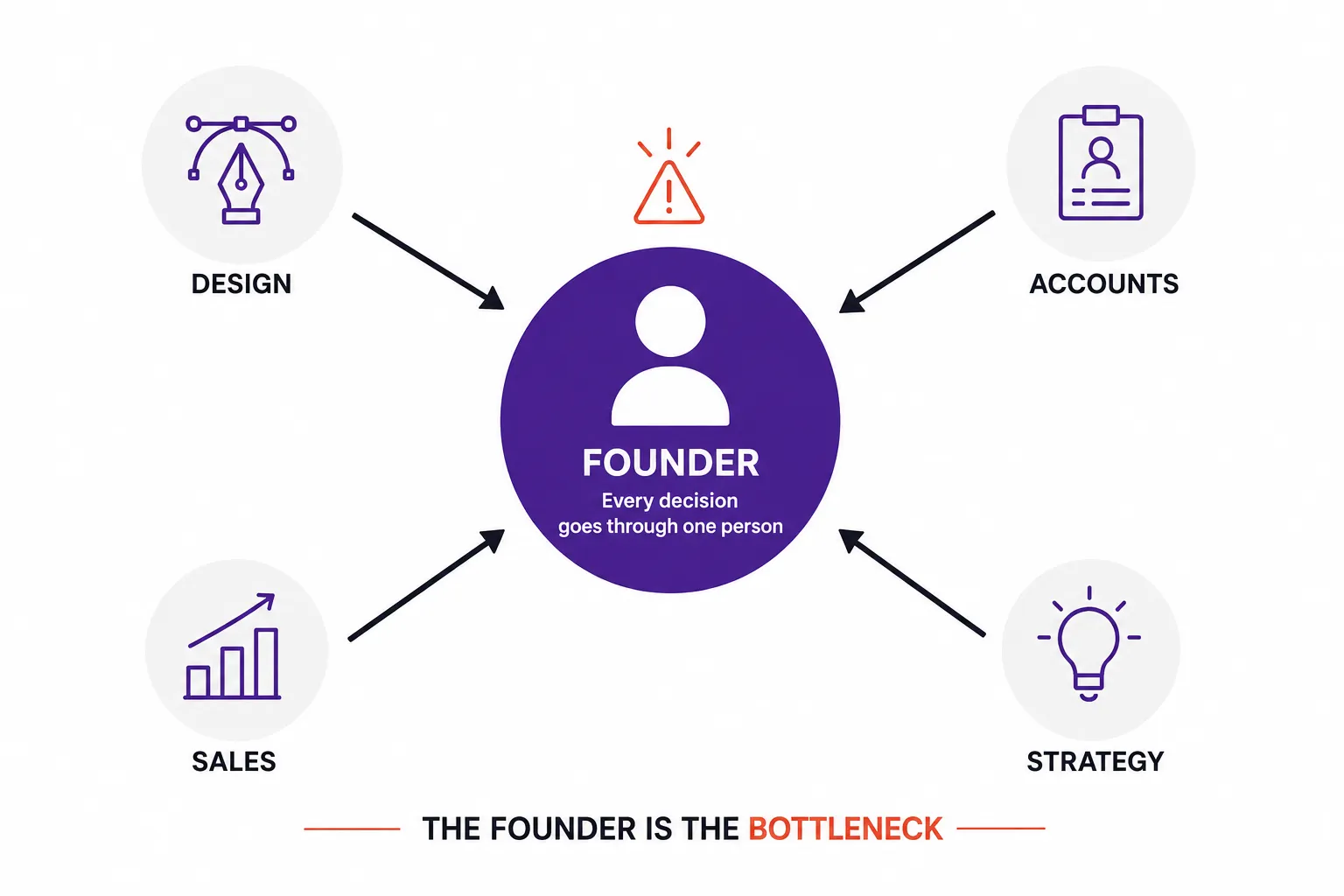
That's the exact wall Jason Swenk hit with the hundreds of founders he now coaches through it. He sold his own agency, spent years listening to more of them describe the identical plateau, and landed on one line for it: most agencies stuck under a million dollars have "a foundation and founder-bottleneck problem, not a tactics problem." The tactic changes every quarter, a new channel, a new pricing model, a new senior hire. The bottleneck stays exactly where it was, because the founder never stopped being the machine the agency runs on.
We made this same argument in shorter form in a video we posted a few months ago: at ₹1Cr, the founder is the system, and at ₹10Cr, systems run the agency. This is the fuller version of that same idea.
Systems don't replace the founder. They replace the need for one.
A 1Cr agency sells campaigns, reels, and ad accounts, deliverables a client can name and count. A 10Cr agency sells outcomes, growth, market share, category position, things a client cannot build without you. The shift is not about better creative. It is about what the invoice is actually attached to.
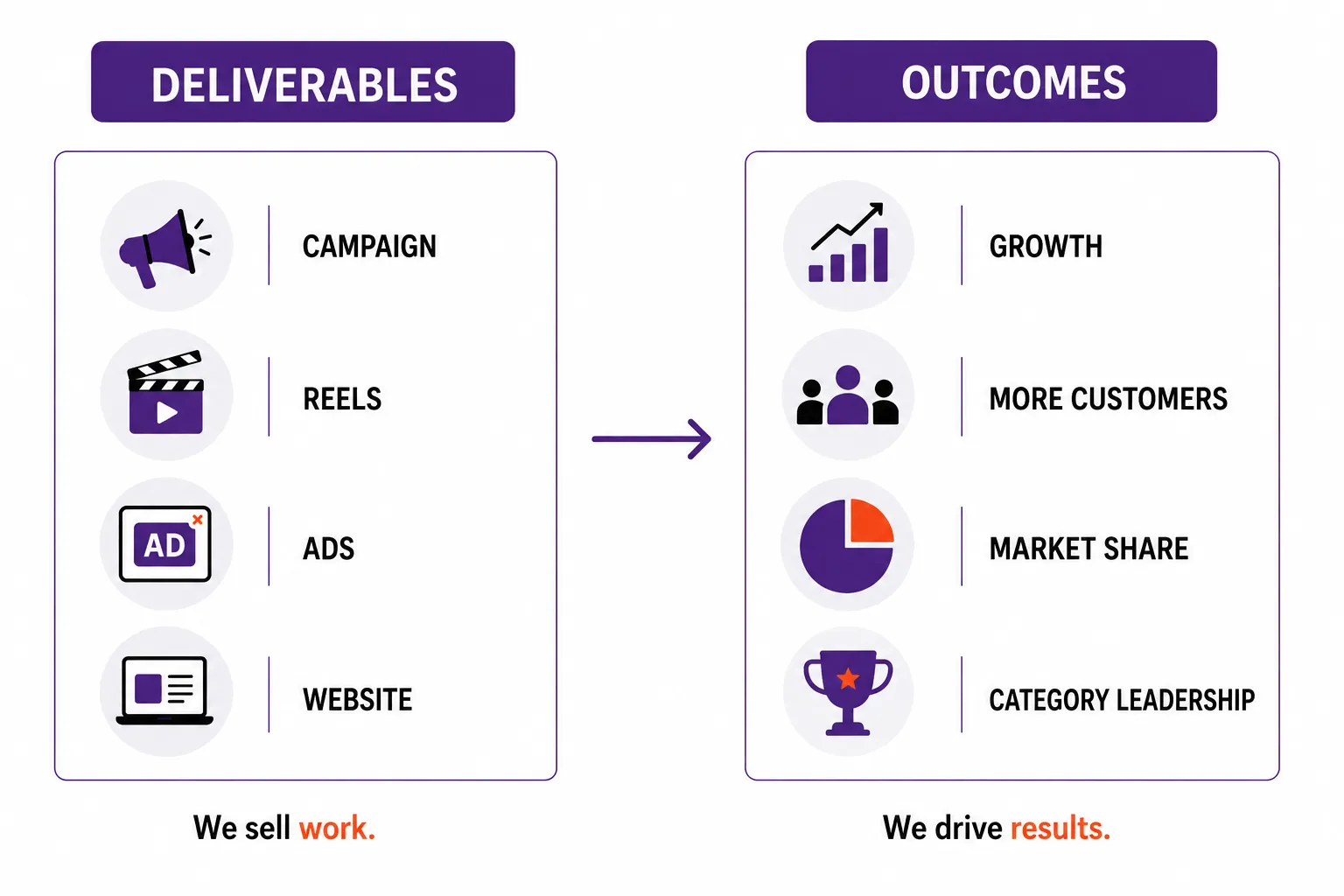
Michael LaVista, who runs the Chicago software studio Caxy, made exactly this move. For years the agency billed for hours and features, and the reception was polite at best, project work that clients approved without much enthusiasm. Once LaVista repositioned the same team around solving specific, high-value business problems instead of shipping software, average deal size moved from roughly 100,000to100,000to500,000, and the agency tripled inside four years. Nothing changed in the room except what the work was being sold as.
This is where most 1Cr founders undersell themselves without realising it. They describe the deliverable, the reel, the campaign, the redesign, because the deliverable is the thing they can point to and defend. A client paying for outcomes is buying something harder to walk away from: a result they cannot easily replicate by hiring someone cheaper.
Execution is something a client can shop for. Outcomes are something they come back for.
1Cr founders take almost any client who can pay, because every rupee feels necessary. 10Cr founders ask a harder question before saying yes, can they genuinely move the needle for this specific client, or does the invoice just feel too good to refuse. That filter is not an act of pride. It is what makes the agency legible to the market.
That question, can we actually create real impact here, is different from can we win this deal. A 1Cr founder is trained to answer the second one, because a closed deal is what pays the bills that month. A 10Cr founder has learned to sit with the first one, even when saying no costs real revenue this quarter.
That discipline often shows up as a pattern before a founder ever names it on purpose. For example, if most of your best, most profitable clients already sit inside one industry, that is rarely a coincidence, it usually means you have already found where you create real impact, you just have not doubled down on it yet. Corey Quinn built his later career noticing exactly this. While running marketing at Scorpion, he watched the agency grow from roughly 20millionpast20millionpast150 million in about six years once it stopped chasing every service business that could pay and built its reputation inside a small number of verticals where it already had proof it could deliver. Quinn now teaches agency founders the same lesson under what he calls specialization over generalism: trying to serve everyone is usually how a business ends up mattering to no one in particular.
The hard part is not identifying the filter. It's holding it when a client outside it shows up with a real budget and an urgent deadline. That single moment, saying no to money that does not fit, is usually the clearest signal of which agency a founder is actually building.
A client roster with no filter is not reach. It is noise with an invoice.
Hustle is what got the agency to 1Cr, and it is not what gets it to 10. Hustle is what a founder does when there is no other option, answer every client message personally, write every proposal, sit in every kickoff, fix every fire before a client notices it. It works, and it is exhausting in a way that eventually shows up as a ceiling rather than a badge.
Structure looks unglamorous next to it, a documented process for how a project actually gets delivered. A second layer of people who can make a real call without escalating it. Client standards that live in a shared system instead of one person's memory of how things are usually done. None of it makes for a good reel. All of it is what lets the agency run on the Tuesday the founder is not in the building.
The agencies that make this shift, the ones going through the actual 1Cr to 10Cr transition rather than just talking about it, tend to build three things around the same time:
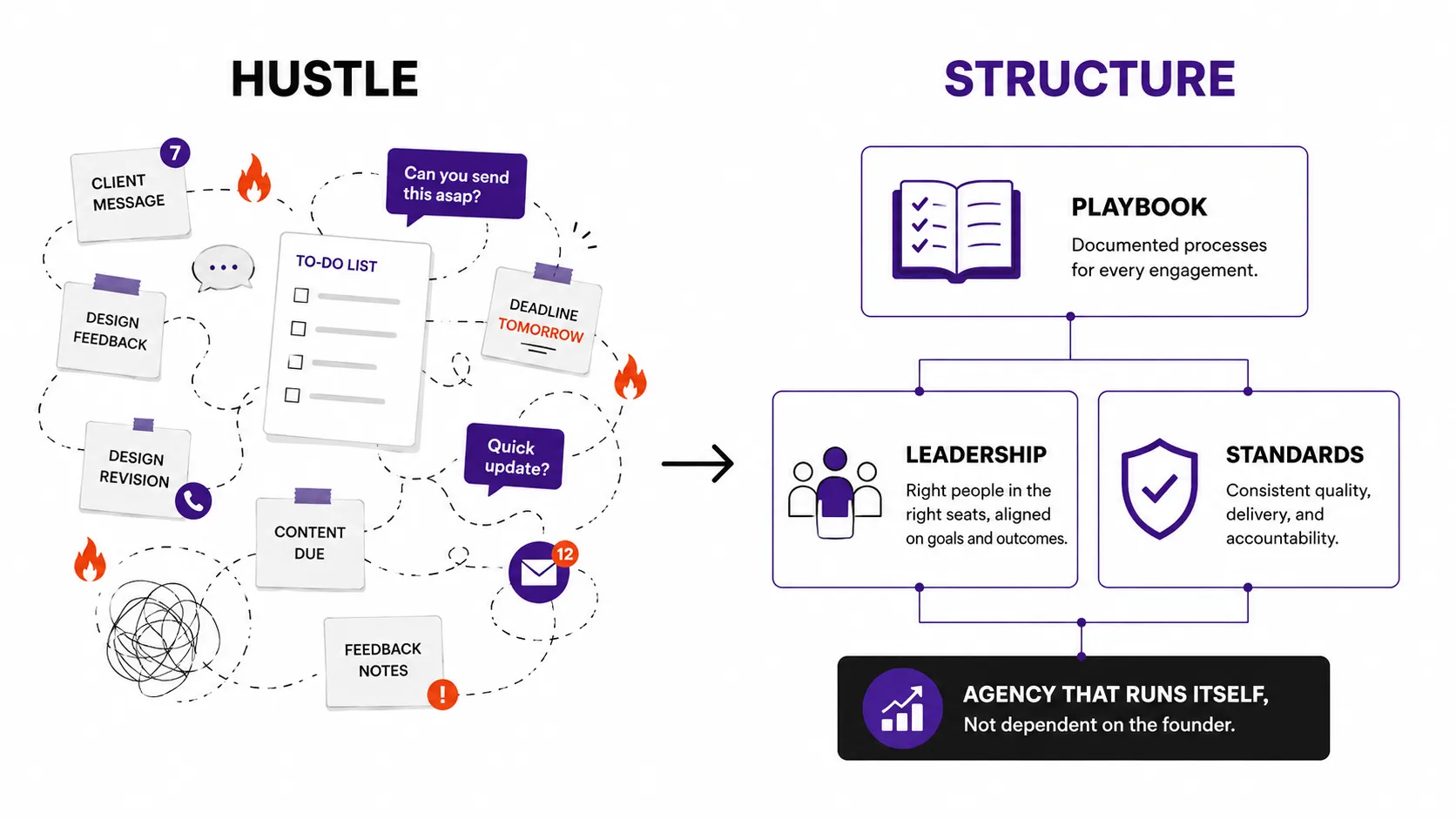
Structure is slower to build than hustle is to summon. That is exactly why most founders skip it until the hustle stops working.
Busy and built are not the same thing, and most 1Cr founders cannot yet tell the difference from inside the week. A full calendar feels like progress, and a pipeline of active projects feels like momentum. Neither one tells you whether the agency is becoming something, or just staying in motion.
The founders who reach 10Cr describe the shift differently once they are on the other side of it. They stop asking what project is next and start asking what the agency is actually becoming, whether it could survive a bad quarter, a lost client, or a founder on medical leave. Busy work crowds that question out before it ever gets asked.
None of this means the 1Cr founder is doing something wrong. Every agency starts as a collection of projects, because that is the only thing there is to sell at the start. The mistake is staying there past the point where the agency could have been designed on purpose instead of accumulated by accident.
The four differences above are not really about money, clients, or hours. They are downstream of one thing: how a founder answers the question of what they are actually for inside their own agency. A 1Cr founder answers that question with their own hands. A 10Cr founder answers it with a structure they designed and then trusted.
This is where the founder mindset for scaling a business actually lives, underneath the revenue number, not above it. Revenue is a lagging signal. Identity is the thing generating it. A founder who still needs to be the smartest person in every room, the final approval on every brief, the person whose energy the team takes its cue from, has built an agency shaped exactly like that need. It will not outgrow the need, because the need is what the agency was built around.
What changes at 10Cr is not that the founder cares less. It is that the founder has separated their own worth from their own necessity. The agency does not need them in the room for it to still be theirs.
There is a fast way to check which side of this you are actually on, and it does not require a revenue number.
None of these questions have an answer that flatters everyone. Most 1Cr founders will not like a few of their own answers, and that is a more useful outcome than a comfortable one.
The agencies that make it to 10Cr are not run by the most talented founder in the room. They are the ones where the founder decided, early enough, to stop being the whole business and start building something that could hold its shape without them. That decision does not show up on an invoice. It shows up years later, in whether the agency is still standing, and whether the founder still wants to be in it.
None of this is theoretical for The Cofoundry. Akshay Gurnani built Schbang from a small studio into a marketing collective spanning three countries, more than 1,200 people, and close to ₹250 crore in annual recurring revenue, before stepping away in 2025. What he carried out of that decade was not a tactics playbook. It was a precise view of exactly where founders get stuck between 1Cr and 10Cr, and what actually moves them past it.
The Cofoundry exists to sit inside that exact problem with agency founders and brand leaders who are ready to make the shift on purpose instead of by accident. If this sounds like where your agency is right now, reach out to us. We are always glad to talk it through.
The clearest shift is from being the agency's engine to designing one. A 1Cr founder personally carries decisions, delivery, and client trust. A 10Cr founder has moved that weight into documented structure, a leadership layer, and a clear client filter, so the agency's output no longer depends entirely on the founder's personal bandwidth.
Working harder adds more hours to the same structure, it does not change the structure itself. This is a well-documented agency founder mindset problem: research drawn from more than 70 independent agency founder interviews found that agencies plateau not from a lack of effort but from a founder who never stopped being the single point every decision has to pass through.
Founders past 1Cr typically build a specific filter, a client type, budget size, or problem they are genuinely built to solve, and hold to it even when a client outside that filter can pay. The filter is what lets the market understand what the agency is actually for, rather than treating it as a generalist vendor open to anyone.
No. Some founders deliberately keep an agency small and highly profitable rather than scaling headcount, and that choice can be just as durable as scaling up. What matters is whether the decision was made on purpose, with a structure designed to support it, rather than an agency that stayed small only because no one ever changed how it ran.
Start by naming one decision that currently requires you personally, every single time, then hand over the actual judgment behind it, not merely the task, to someone else this month. That single handover is usually the first real evidence that the agency can run on structure rather than on the founder's personal attention.


.svg)

.svg)


.svg)


