.svg)



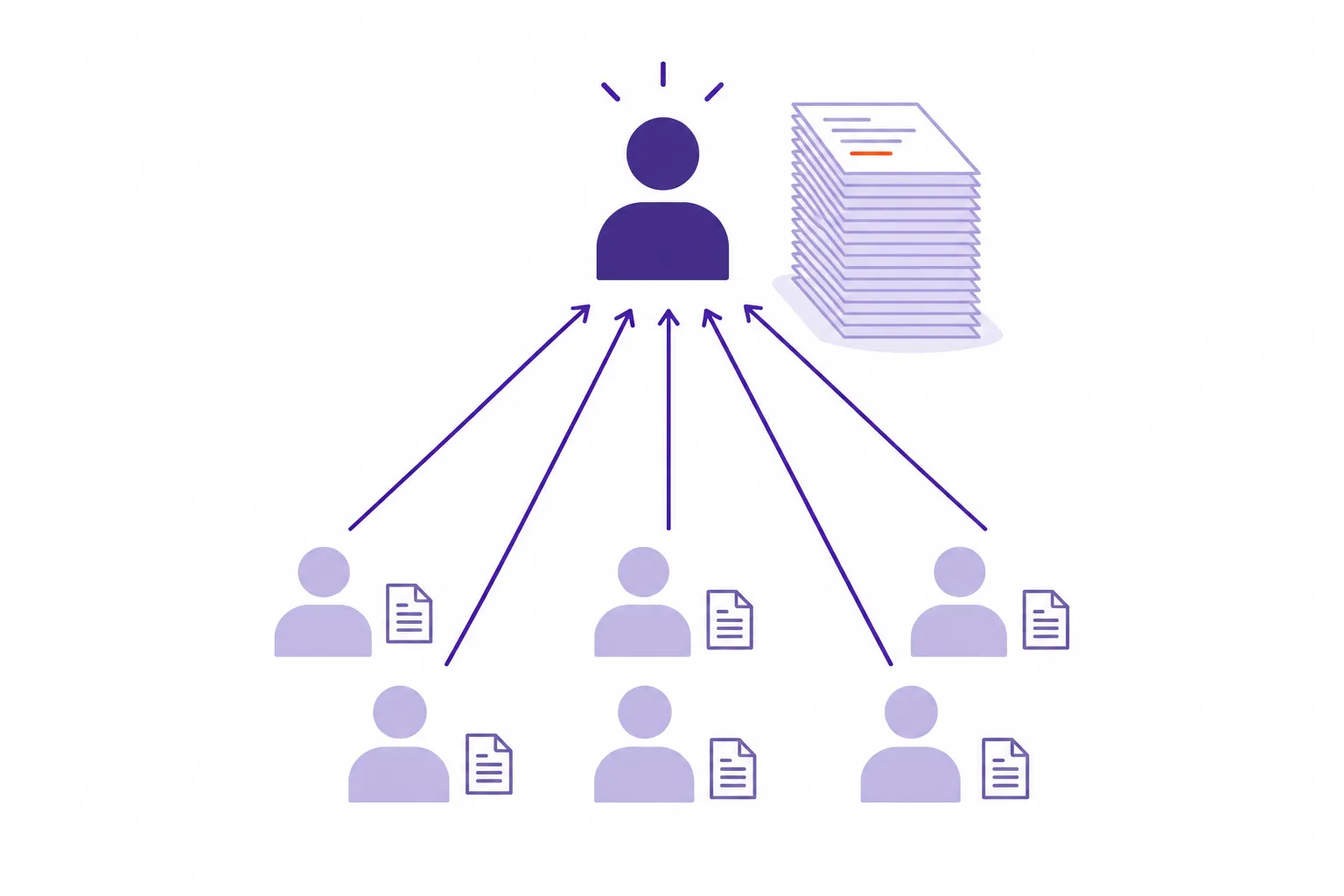
The clearest sign of a founder bottleneck is not a packed calendar or a 70-hour week. It is the moment a founder returns from two weeks away and discovers that a dozen meaningful decisions were held in place, waiting for one brain to come back.
The team is capable. The work is good. The clients are satisfied. But the agency moved at half speed because the people running it were waiting for the founder to weigh in, and the founder was not there.
Most founders read this as a confidence problem. They tell themselves the team needs to back themselves more, that the culture around decision-making needs to shift. So they delegate. They assign tasks, hand off execution, build out their leadership layer. And the agency stalls again the next time they step away.
Because the tasks moved but the thinking did not.
This is the pattern beneath most agency founder bottlenecks: the founder becomes the single point through which every meaningful decision has to pass. The instinct is to solve it by giving more work away. But task delegation and thinking distribution are two distinct things, and conflating them is what keeps most agency founders running the same loop.
McKinsey's research on decision-making makes the performance cost visible: organisations with fewer reporting layers make decisions markedly faster. Seventy percent of people at companies with one to three layers say decisions happen quickly, against thirty-eight percent at companies with seven or more. Speed of decision is not a function of how hard the founder works. It is a function of how decision-making is structured, and structure is the thing most founders never touch.
The difference between distributing tasks and distributing the thinking behind them is what this post is about.
A founder bottleneck is not a capacity problem and it is not a trust problem. It is a design problem. When only one person in the agency is authorised to set direction, assess risk, read morale, spot opportunity, and generate new ideas, the agency can only move as fast as that one person, regardless of how many tasks have been handed off to others. The bottleneck is not in the work. It is in the thinking that precedes the work.
The distinction matters because it changes the solution entirely.
Delegating a task means assigning a deliverable: you own the client report, the campaign timeline, the hiring brief. Distributing a thinking mode means assigning permanent judgment: you own the risk assessment in this domain, you own the directional call when competing priorities clash, you own the read on team morale and what it is signalling. When a task is delegated without the judgment that governs it, the task-holder still escalates back to the founder every time a real call needs to be made.
Most agencies have delegated the work but never distributed the judgment. That is why decisions keep returning to the same desk.
Consider a senior account manager who handles client relationships but checks with the founder before responding to any escalation outside the usual scope. The task is theirs. The risk assessment, the judgment about what response is appropriate, what the client relationship can absorb, what precedent the response sets, remains the founder's. Nominally, ownership has been distributed. Structurally, the bottleneck is intact.
The agency can only grow as fast as its thinking can scale. If all six thinking modes stay with one person, the ceiling of the agency is one person's bandwidth.
In 1985, Edward de Bono published Six Thinking Hats, a framework for improving decision quality in meetings. His core observation was precise: meetings fail because people argue across thinking modes. One person is in risk mode, another in optimism mode, a third pushing for more data, and the conversation circles rather than advances.
His solution was parallel thinking, getting everyone in the room to wear the same hat simultaneously. In the Black Hat phase, everyone surfaces risks together. In the Yellow Hat phase, everyone looks for upside together. Rather than debating across modes, the group moves through them in sequence. De Bono's framework is a meeting protocol, and an effective one.
But it was designed for a one-hour room, not an ongoing organisation. The six hats in his model are thinking postures that any individual can adopt temporarily, not permanent roles that structure how an organisation makes decisions day to day.
Agency founders have a fundamentally different problem. The six modes are not colliding inside a single meeting. They are permanently strapped to one person, running simultaneously, across every conversation, every brief, every client call, every hire, every piece of work that needs a decision before it can move forward.
De Bono gave us the vocabulary: six distinct modes of thinking, each one real, each one necessary for a sound decision. What he applied to a single meeting, the agency has to apply to its entire structure. The six modes still hold. What changes is the timescale and the ownership, from wearing each mode in sequence for an hour to holding it permanently across a leadership team. Parallel thinking keeps a room productive for an hour. Distributed thinking keeps an agency moving when the founder is not in the room at all.
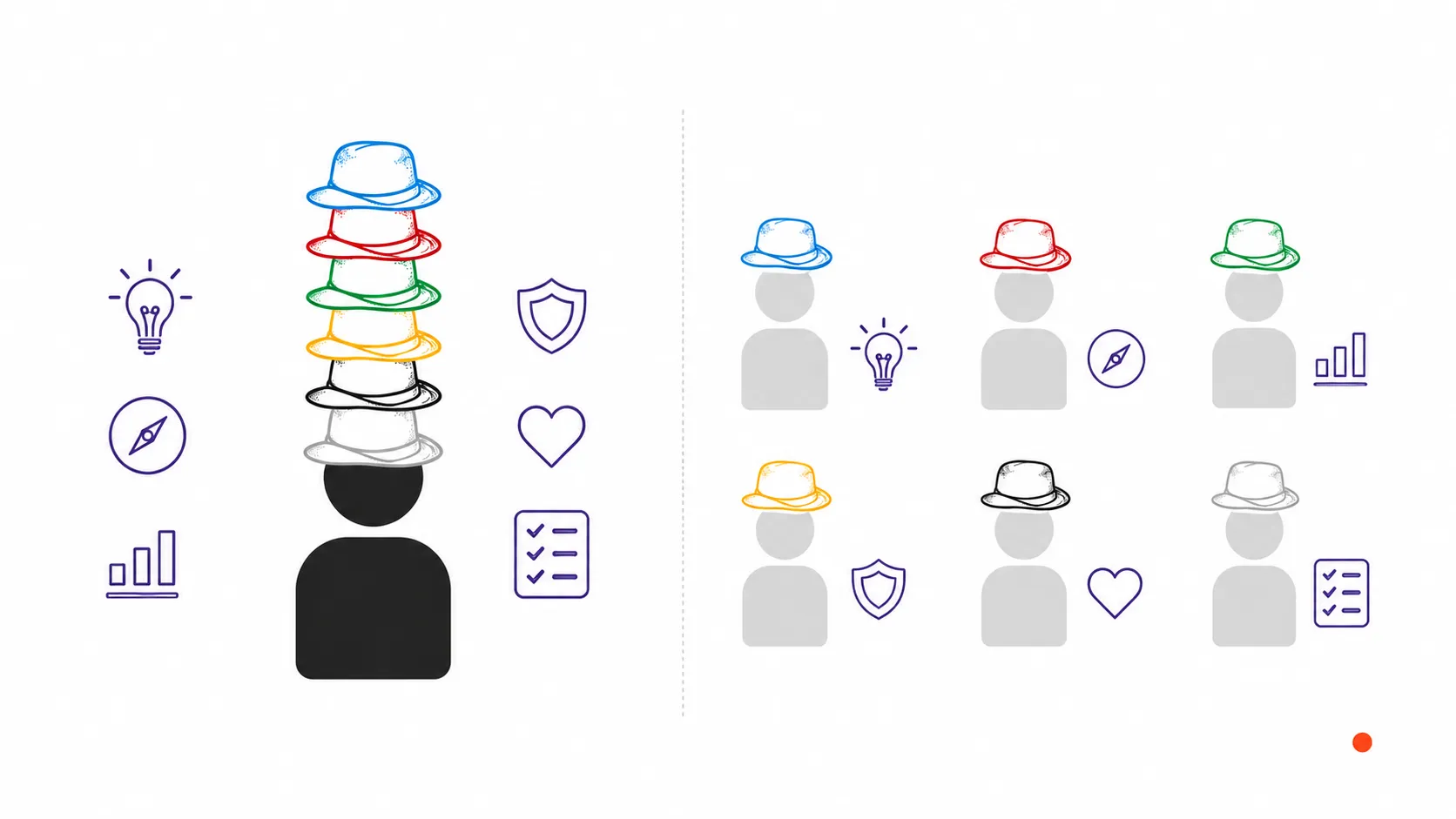
When all six thinking modes, direction, facts, gut, risk, optimism, and ideas, remain permanently with the founder, the agency does not simply slow down. It builds a structural dependency that compounds over time. Every new senior hire inherits the same bottleneck. Every growth phase hits the same ceiling. The founder works harder while the agency moves slower, and the longer the structure goes unchanged, the wider that gap grows.
Here is what each hoarded mode costs in practice.
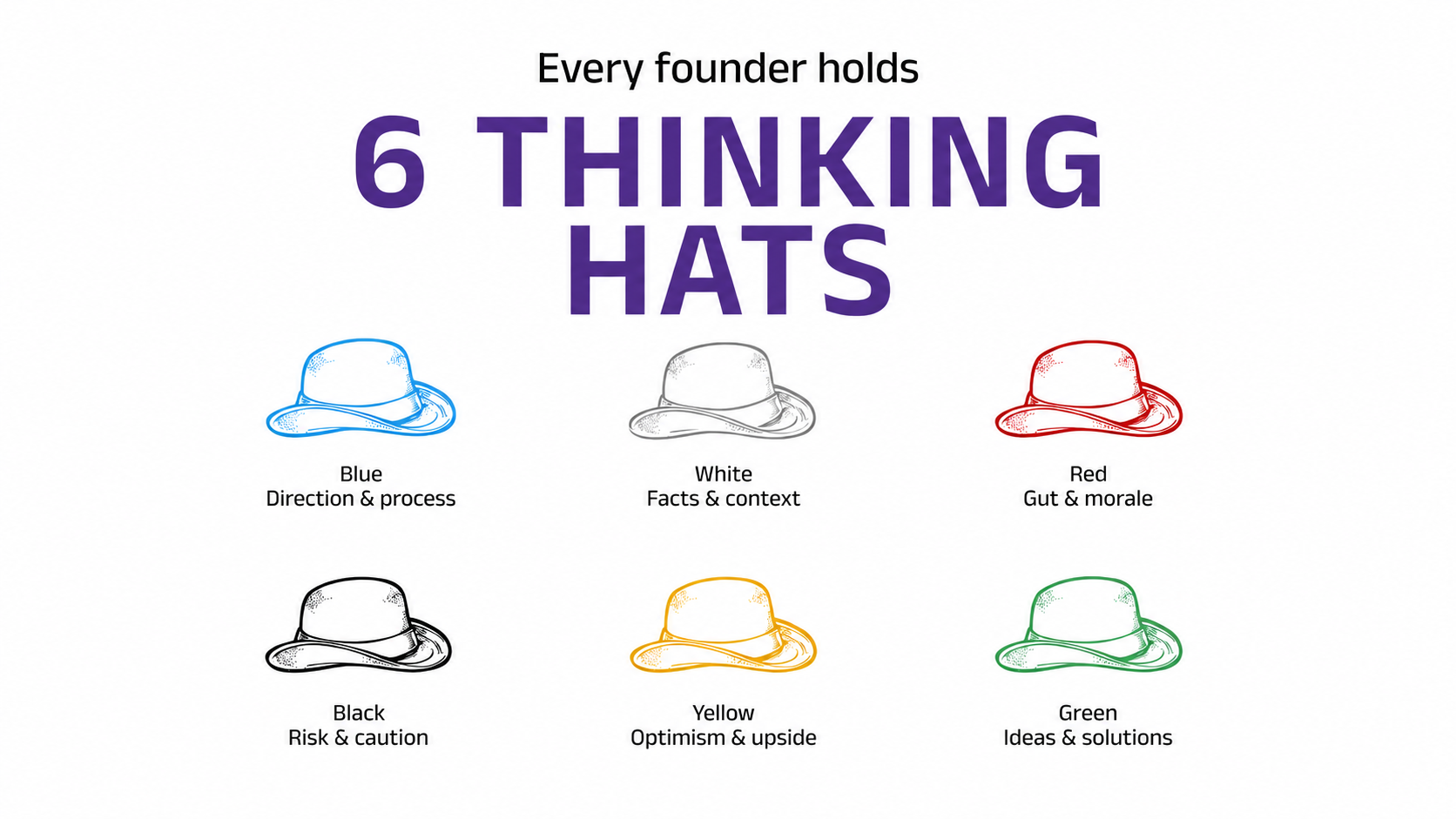
Blue hat (direction and process). Every brief, every campaign structure, every operational standard defaults to the founder. Senior team members develop strong execution skills but never develop the judgment to set a direction independently. Three years in, the founder is still required in every kickoff because no one else has been given the authority, and the accountability, to run them.
White hat (facts and context). Data and context live in the founder's head. When the founder is not in the room, decisions get made without them, or they wait until the founder is available. Neither outcome is functional at scale, and both erode the team's confidence in their own ability to make sound calls.
Red hat (gut and morale). The team reads the founder's energy to calibrate their own. Culture becomes mood-dependent rather than structure-dependent. When the founder is engaged, the office follows. When the founder is under pressure, the entire team absorbs it without understanding the source.
Black hat (risk and caution). Without a designated risk voice, two failure modes emerge. Either everything gets approved because no one wants to be the person who said no, or nothing moves because the team is paralysed without explicit founder sign-off. Both versions stall the agency, just in different directions.
Yellow hat (optimism and upside). Opportunity recognition only happens when the founder has mental space for it. If the founder is running at capacity on operations, the lateral moves, the partnership, the new service line, the underserved client segment, go unnoticed or get deferred until it is too late to act on them.
Green hat (ideas and solutions). The team executes existing thinking but does not generate new thinking, because generating new thinking requires someone to own the green hat, to propose an unexpected direction and take responsibility for that call. When that permission stays with the founder, the agency stops producing original ideas and starts processing instructions indefinitely.
The cost is not marginal and it is not abstract. It is the compounding price of a bottleneck that was never redesigned, paid in slower decisions, missed opportunities, and senior people who never grow into the judgment the agency needs from them.
Delegating decision making in an agency becomes meaningful only when it reaches the thinking level, not just the task level. Genuine distribution means giving a specific person permanent ownership of a specific mode, the authority to think in that mode independently, and the accountability for decisions made within it. Without both elements, the hat has not moved. The founder has simply added a layer of sign-off and called it delegation.
The mechanics are simple, and they are the same for every mode. Sit down for a thirty-minute handover. Name the first decision you are going to stop making. Say the sentence out loud that hands it over. Then hold yourself to one rule: if the decision comes back to you, you broke the handover, not them.
Here is how that plays out across the six modes.
Blue hat (direction and process) goes to an operations lead or chief of staff. The first decision you stop making: how work flows when two priorities collide. The handover line: "From now on, when priorities clash, you make the call on sequencing. You do not run it past me first." The signal it has genuinely moved: you are no longer pulled into process conversations that do not require strategic input.
White hat (facts and context) belongs with a strategy or insights lead who controls the information the agency uses to decide. The first decision you stop making: which data a call gets referenced against. The handover line: "You own what we know before we decide. If the room needs context, they come to you, not me." The signal: decisions are being referenced to data you did not personally gather or surface.
Black hat (risk and caution) requires an explicit mandate, because most agencies avoid assigning it, no one wants to be the person whose job is to say no. Give a senior team member both the authority and the expectation to flag problems early. The first decision you stop making: whether a risk is big enough to escalate. The handover line: "You call the risk on new clients and new commitments. Decide what matters, act on it, do not wait for my sign-off." The signal: issues reach you already assessed, not raw.
Yellow hat (optimism and upside) sits with a growth or business development lead who owns the forward-looking view. The first decision you stop making: which opportunities are worth the agency's attention. The handover line: "You own what we chase next. Bring me the shortlist, and you decide what makes it." The signal: opportunities are identified and brought to the table without you having to spot them first.
Green hat (ideas and solutions) belongs with a creative director or senior strategic lead with both the mandate to propose unexpected directions and the accountability to defend them. The first decision you stop making: whether a direction is allowed to be explored. The handover line: "You can greenlight a direction I have not seen. Defend it on its merits. You do not need my pre-approval to put it in front of a client." The signal: briefs generate directions you did not seed and did not pre-approve.
Red hat (gut and morale) is the hardest to assign because it feels most personal, but a strong people lead can own team morale as a structural function rather than a cultural accident. The first decision you stop making: reading and acting on shifts in team energy. The handover line: "You own the read on how the team is doing and what we do about it. You do not wait for me to notice." The signal: you are no longer the primary barometer for every shift in the team's energy or confidence.
One test applies to all six modes. If the person assigned a thinking mode still seeks the founder's approval before acting within it, the hat has not moved. The question to ask is not "have I delegated this?" but "does this person make consequential calls in this domain without checking with me first?"
When thinking modes have genuine owners, the agency does not just move faster. It develops multiple minds. The senior team builds judgment rather than execution muscle. Decisions get made at the level where they belong, by the people with the clearest context and the clearest accountability. The founder stops being the bottleneck and starts being what the agency actually needs, the person who holds and evolves the vision, not the person every decision queues behind.
At The Cofoundry, we have seen this transition happen in agencies at different revenue stages, and the shape of it is consistent. The founder's thinking does not disappear from the agency when the hats are distributed. It gets absorbed into the structure. The questions they would have asked become the questions the team learns to ask. The risks they would have flagged become the risks the designated lead is expected to flag. The permission they would have granted becomes the authority the green hat holder exercises independently.
It is the obvious objection, and it is worth answering directly. Distributing thinking can sound like a case for building a senior leadership team and letting them run. It is not the same thing, and the difference is the whole point.
A senior hire takes on a domain. But they carry it the way an employee carries it, with the founder still holding the consequence if the call goes wrong. That is the mechanism that keeps judgment boomeranging back to the founder. The cost of a wrong decision still lands on one person, so one person stays in every loop, no matter how many capable people sit around them. You can hire six excellent leaders and still be the bottleneck, because the weight of being wrong never left your desk.
Distributing thinking only works when someone holds real decision-weight alongside the founder, not beneath them. That is the difference between adding a layer of management and changing the structure of how the agency thinks.
This is the work The Cofoundry does with agency founders. We come in as a thinking partner, helping diagnose which modes have no permanent owner, designing the accountability structure, and building the system that runs without us in the room. We hold the weight of the calls a co-founder would hold. We take no equity for it. The stake we hold is the mandate, and we are measured on whether the agency runs when neither the founder nor we are in the room.
When a thinking mode has been hoarded for three or four years, it stops looking like a bottleneck and starts looking like how things work. The pattern only becomes visible from outside. When hats are assigned and not hoarded, the agency stops running on the founder's capacity and starts running on architecture.
Co-founder mindset. Zero equity taken.
The founder bottleneck occurs when an agency's decision-making, including the thinking behind those decisions, remains centralised with the founder even as the team grows around them. It happens because founders centralise thinking out of necessity in the early stages, when they are the only person with the full context to make calls. By the time this becomes a structural problem, the pattern is invisible because it has come to feel like leadership. The agency stalls not because the team lacks capability, but because no one has been explicitly authorised to think independently in the domains the founder still owns.
The clearest signal is that decisions within your team's own domains still require your approval before they move. If a senior account manager checks with you before responding to a client escalation outside the usual scope, if the creative team waits to read your reaction before committing to a direction, if the operations lead defers to your judgment on process decisions they could reasonably make, the tasks may be distributed but the thinking modes are not. The sign-off has simply been renamed delegation. The hat is still yours.
Delegating a task means assigning a deliverable to someone. Distributing thinking means giving someone permanent ownership of a judgment domain, the authority to think in that mode independently, and the accountability for decisions made within it. When **delegating decision making** stops at the task level, decisions still escalate to the founder because no one has been given the mandate to own the underlying judgment. Genuine distribution requires both authority and accountability, not just the work itself.
Start with the modes that have the least strategic sensitivity and the clearest ownership signal. White hat (facts and data) and blue hat (direction and process) typically move cleanly first because the outcomes are measurable and the accountability is straightforward to define. Black hat (risk and caution) requires an explicit mandate, it needs to be assigned directly, not assumed. Red hat (gut and morale) is often last because founders find it most personal, but a strong people lead can own it structurally. The test for each mode: if the assigned person still seeks founder approval before acting in that domain, the hat has not yet moved.
Earlier than feels necessary. Most agency founders wait until the bottleneck is causing visible damage, missed deadlines, frustrated senior hires, decisions backed up for weeks, before they address the structure. By that point, the habits are deeply embedded and the senior team has already learned to wait. The right moment to begin distributing thinking modes is when the first senior hire joins and takes on a domain that used to belong entirely to the founder. That is when deliberate ownership design matters most, not informal delegation with the hope that judgment will follow.


.svg)

.svg)
.svg)


