.svg)




Most agency co-founders think they have a values problem. They have a structure problem. Co-founder conflict rarely starts because two people want different things. It starts because two people want reasonable things, and the agency has no agreed rule for which one wins when they collide.
A retainer lands on a Tuesday, and one of you reads the numbers first. They are good, healthy margin, clean payment terms, a client who renews without a fight. The other reads the brief first, and it is the kind of work that will never leave the building, never win anything, never make a single good person want to join.
Both of you are right, and that is the part nobody says out loud in the argument that follows.
Because the argument is not really about the retainer. It is about a question your agency has never answered on paper: when commercial return and creative ambition point in opposite directions, which one wins, and who gets to say so. A founder wrote to us with exactly this, three years into building an agency with a co-founder he still liked and still rated, and we answered it in a recent AMA. The problem he described was not the problem he had.
Leave that question unanswered and it reopens every week, attached to a different brief each time. The specifics change, the argument does not.
What happens next is quiet and expensive. Decisions slow down, because both of you now know that a simple yes will cost forty minutes, and you start pre-arguing in your head before you walk into the room.
Your team works it out well before you do. They learn which founder to ask depending on the answer they want, and eventually they stop bringing the difficult briefs to either of you.
That is not a partnership breaking down. That is a partnership operating without a rule.
Usually the opposite. A co-founder who agrees with you is not a co-founder, they are a second version of you, and a second version of you cannot cover what you miss. The friction you are worried about is a large part of why the pairing works, and what it needs is somewhere to land.
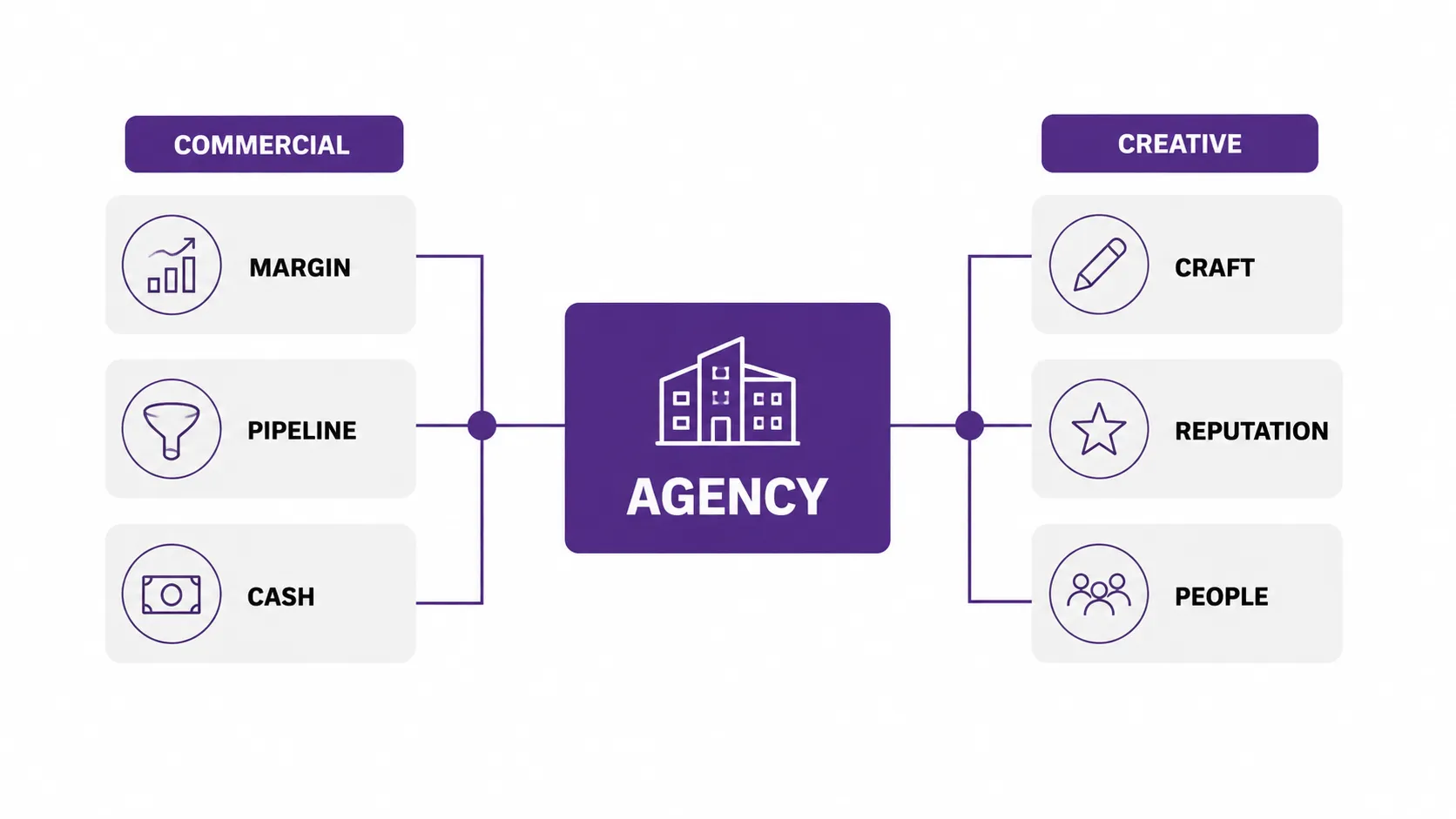
An agency is two businesses sharing a building. One of them runs on margin, pipeline, pricing discipline and cash in the bank. The other runs on craft, reputation, the standard of what ships, and the calibre of people willing to work there.
Neither survives on its own for long. An agency run only on revenue slowly turns into a body shop, winning on price, losing its best people to shops doing better work, and becoming replaceable to the clients it was trying to keep. An agency run only on craft makes beautiful things and cannot make payroll through a slow quarter.
So the two of you are not opponents who happened to start a company together. You are each holding one half of a business that needs both halves held, which is why the argument keeps happening in the first place.
There is one distinction worth being honest about, and it is the only real warning sign in any of this. Are you arguing about the work, or about each other?
"This brief is not worth taking" is a position. It can be scored, tested and settled. "You never think about the P&L" is a verdict on a person, and there is nothing to settle, because the other founder cannot concede it without conceding who they are.
The co-founder conflict that ends partnerships is almost never the first kind. It is what the first kind becomes after it has run for two years with nowhere to go. An argument that never resolves does not disappear, it stops being about the brief and starts being about the person across the table.
Not because either of you changed, but because you gave a real disagreement no way to finish.
You did not pick the wrong partner. You built the right partnership and never gave it a way to decide.
The first thing we tell agency co-founders is that most co-founder conflict over which work to take disappears the moment you stop scoring work on one number. Every brief that comes in gets rated twice, once on commercial return and once on creative ambition, by both founders, independently. The argument then stops being about whose instinct is sharper and starts being about what the work actually scored.
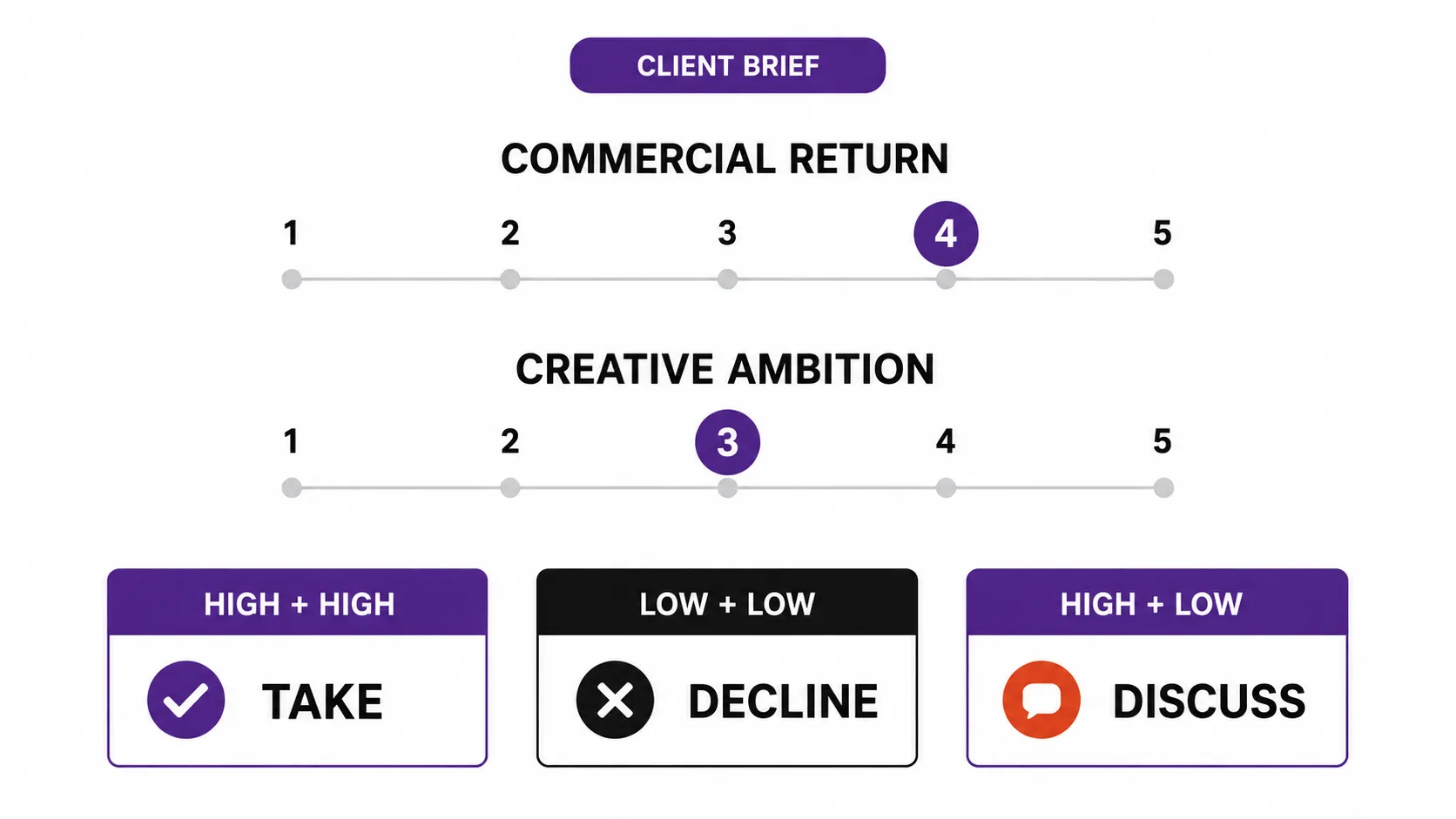
Keep it crude on purpose, five points on each axis, no weighting and no formula. The moment it becomes a spreadsheet with sub-criteria, you have built a second thing to argue about.
What goes into the commercial number: margin, retainer against project, payment terms, how likely it is to renew, and whether it opens a category you have been trying to get into.
What goes into the creative number: how high the craft ceiling actually is, whether the finished work is worth showing, whether it pulls good people toward the agency, and whether it moves the reputation you are trying to build.
Score separately, then put the two sheets next to each other. Three things happen the first time an agency does this.
Most of the arguments disappear. Briefs that score high on both get taken without a discussion, briefs that score low on both get declined without one either, and it turns out a large share of your fights were about work that was never genuinely borderline.
The real decisions get isolated. What is left is the brief that is commercially strong and creatively thin, or the reverse, and those deserve a proper hour of both founders' attention. Very little else on the list does.
You find out what you actually disagree about. Sometimes the scores land within a point of each other and the fight was about tone rather than substance. Sometimes they are four points apart, and you have just learned something useful about how differently the two of you read the same brief.
Then agree the mix you are willing to carry. What share of the book can be commercially strong and creatively thin before the agency stops being one you would want to work at?
Agencies that survive lean quarters usually run some of that work, and agencies that keep their best people do not run only that work. Pick the ratio in a quarter when nothing is on fire, and let the scorecard hold you both to it.
The mix is a decision you make once. Without it, you make it again every Tuesday.
Splitting roles is the easy half, and most co-founders get there without help. One takes commercial, pricing, pipeline and business development. The other takes creative, craft, hiring and the standard of what leaves the building.
Then they stop, because role clarity feels like alignment.
It is not. Two founders can run their halves competently for a year and still be building two different agencies, because nobody checked whether the halves were still pointing at the same thing.
Picture where that lands eighteen months in. The commercial founder has been optimising for retainer stability and has quietly filled the book with clients who never brief anything worth doing. The creative founder has been hiring against a standard of work the book can no longer support.
Neither of them did anything wrong on their own side of the line. They simply stopped comparing notes on what they were building together, and the gap between the two halves widened every month nobody looked at it. Most co-founder conflict at this stage does not announce itself as conflict, it shows up as two founders being mildly disappointed in each other for reasons neither can name.
Ownership divided is efficiency, vision divided is two agencies inside one company.
The fix is smaller than the problem. Thirty minutes a week, in the same slot, and it is not a status meeting. It is one question: are we still building the same agency? What did we say yes to this week, what did we say no to, and does that pattern match the thing we said we were building?
Divide the work. Divide the decisions. Never divide the direction.
The architecture of a partnership is not the split of roles. It is what the partnership does when the two halves disagree, and that is the part almost nobody designs.
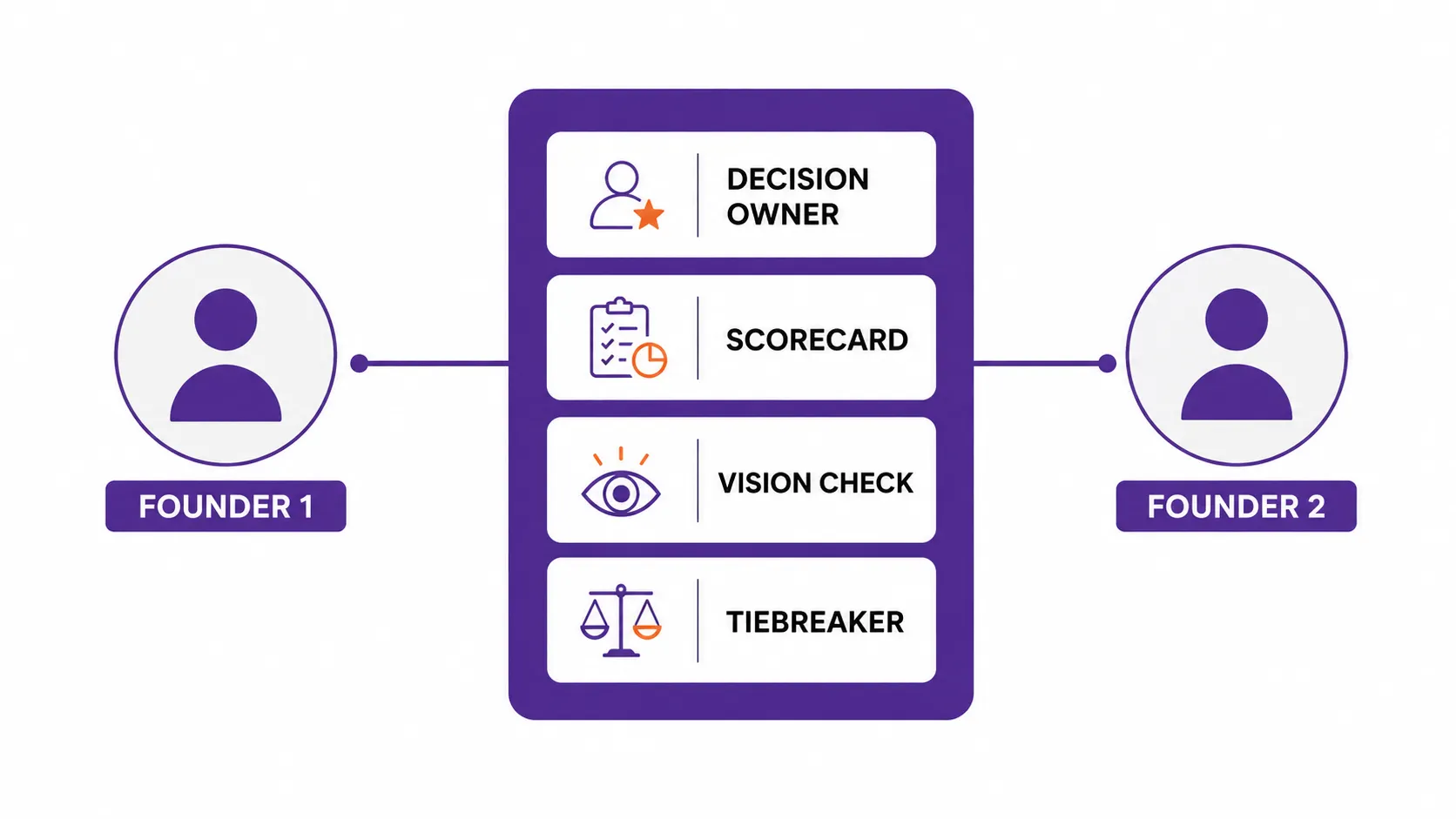
A tiebreaker, named in advance, while nothing is at stake. Two co-founders with equal standing and opposite instincts will eventually deadlock on a call that could genuinely go either way. Without a third perspective agreed beforehand, the deadlock gets resolved by whoever cares more, or whoever holds out longest.
Harvard Business Review makes the case for identifying a third party before you need one, and it is the step most founding pairs skip, because naming a mediator while things are calm feels like an admission that things will not stay calm.
Three people tend to qualify:
What disqualifies someone matters just as much. Anyone who reports to one founder and not the other, anyone with a stake in the outcome, and anyone either of you went out and found in the middle of the argument.
A tiebreaker agreed in advance is a structure. The same person pulled in mid-argument is one side bringing an ally, and everybody in the room can tell the difference.
Agree the terms while you are still calm, because the terms are the part that does the work. The tiebreaker's job is not to be right, it is to end the decision so the agency can move, and both founders commit beforehand that the call stands and that whoever lost it helps it succeed.
The cost of a decent decision made this week is almost always lower than the cost of a perfect one made in six.
None of this needs a consultant, a workshop or a new tool. It needs an afternoon, and a willingness to have five conversations you have both been postponing.
What makes this hard is not the mechanics. Every item on that list forces a conversation one of you would rather put off.
Writing down who owns a decision means telling your co-founder that a call is not theirs. Agreeing the mix means committing to a number about work neither of you has seen yet. Naming a tiebreaker means admitting out loud that you will deadlock.
All five conversations are cheap this quarter and expensive next year.
Most founders can see all of this on their own. Very few build it, because building it means one of you has to step out of the agency long enough to design how the agency decides, and there is always a pitch on Thursday.
That is where we come in.
The Cofoundry sits inside the agency with both founders rather than advising from the outside. We help set the two numbers every brief gets scored on, hold the weekly vision check when the week is too full for the founders to hold it themselves, and act as the tiebreaker you agreed on while things were calm. Being outside the friendship and inside the business is what makes a third perspective usable.
Co-founder conflict is rarely what gets us called in. It is usually the symptom that makes a founder pick up the phone, and the mediation is only the visible part of the work.
The larger part is the architecture underneath it: how the agency prices, how it decides what to take and what to turn down, how ownership gets distributed as the team grows past the point where two people can hold it, and how the founders stop being the two bottlenecks every decision has to route through.
We have argued before that the best decisions come out of debate rather than agreement. That only holds when the debate has somewhere to land, and building that landing place is the work.
Agencies do not scale on effort, they scale on design. We take no equity for helping build that design, we carry the outcome instead.
Disagreement between co-founders is normal and usually productive, particularly when one founder leans commercial and the other leans creative. The signal worth watching is not how often you argue but what the argument is about. Arguing about a brief, a price, or a hire is healthy. Arguing about each other's character or commitment is what an unresolved disagreement turns into once it has run long enough without a way to finish.
Stop treating it as a debate to be won and turn it into something scored. Rate every brief twice, once on commercial return and once on creative ambition, with both founders scoring independently before they discuss it. Most briefs turn out to be clearly in or clearly out. The handful that score high on one axis and low on the other are the only ones that deserve a real conversation, and agreeing in advance what mix of those the agency is willing to carry settles most of them before they come up.
Split the roles. Two founders making every decision jointly is slower than one founder making it alone, and it removes the main advantage of having a partner. What cannot be split is the direction. Divided ownership needs a standing weekly conversation about whether both halves are still building the same agency, because role clarity feels like alignment without actually being it.
Someone agreed on before the deadlock happens, with no stake in which founder wins and no reporting line to either. A head of strategy who sees both the numbers and the work, a board member or senior advisor, or a client whose judgment both founders trust. Just as important is agreeing beforehand that the tiebreaker's call stands, and that the founder who loses it helps make it work.
When the disagreements stop attaching to specific decisions. A partnership with a structure problem argues about this brief, this price, this hire, and settles down once a rule exists. A partnership with a deeper problem argues about the same thing regardless of what is on the table, and the arguments are about intent and character rather than the work. Build the structure first, because most founding pairs discover the conflict was never about the partnership at all.


.svg)

.svg)
.svg)


