.svg)



Somewhere in most marketing teams is a persona deck nobody has opened since the offsite where it was made.
It has a name, often a face, a stock photo, an alliterative label like "Marketing Mary." It lists her age, her income, her job title, her favourite apps, and describes a customer perfectly. And it predicts nothing. The buyer persona sits in a shared drive, technically complete and practically useless, while the team keeps making decisions on instinct.
This is the gap most teams never name. A persona that describes a customer is a worksheet. A persona that explains how a customer decides is a map. One tells you who is in the room. The other tells you what they will do when you put an offer in front of them.
Most founders think the problem is that their persona is not detailed enough, but it isn't. The problem is that they built the wrong kind of document, one that describes the customer instead of mapping how the customer decides.
The cost of this shows up quietly, in campaigns that look fine on paper and underperform in the market. McKinsey's research on personalisation found that 71% of consumers now expect companies to treat them as individuals, and 76% get frustrated when they don't.
Sit with that. People expect to be understood as individuals, and a demographic profile is built to do the opposite: it sorts them into a segment and stops there. Knowing a customer is a 34-year-old urban woman tells you nothing about what she is trying to buy, or what would make her walk away.
The reason is structural: demographic data is easy to collect and easy to agree on, so that is what most personas are made of. Age, location, seniority, income band, none of it tells you why someone buys, hesitates, or walks. A target audience defined by attributes is a description, and the decisions you need to win happen somewhere the description never looks.
This is where the buyer persona has to change from a profile into a working tool, not a richer description but a different object entirely.
Most buyer persona work fails because it begins with demographics instead of decisions. A profile built on age, title, and income describes a stranger you could pass on the street. It cannot tell you what that stranger fears, what they have already tried, or what would make them say yes. So the persona gets built, approved, and ignored.
The deeper issue is that demographic personas are built on assumptions rather than evidence. As one analysis of why personas keep failing puts it, most are static summaries assembled in a workshop, not living pictures drawn from real customer behaviour. They feel productive to make and change nothing about how the team works.
Here is the test we give brands, call it the drawer test. Pull up your buyer persona and ask one question: when was the last time someone changed a decision because of it? Not referenced it in a deck, but actually changed a call. Killed a campaign idea, rewrote a landing page, reordered a launch sequence.
If the honest answer is "never," the persona failed the drawer test. It describes, but it does not decide.
A persona you never argue with is a persona you never use. The ones that matter are the ones a team reaches for when two smart people disagree about what to ship.
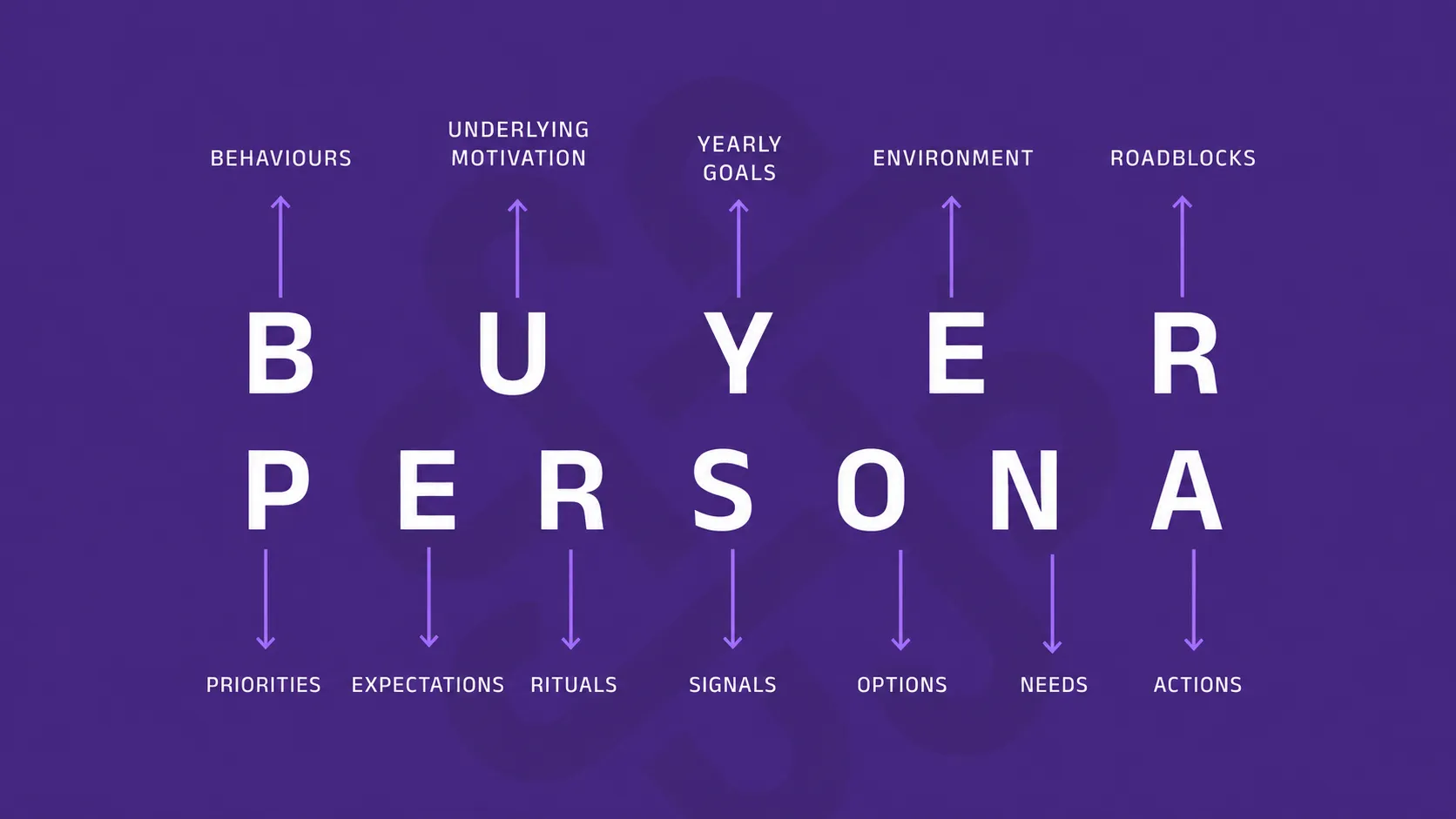
A buyer persona is a map of how a customer decides, not a portrait of who they are. It captures the behaviours, motivations, barriers, and expectations that sit behind a purchase. Demographics tell you the customer exists, while the decision map tells you what moves them, what stops them, and what they need to see before they act. We made this case on LinkedIn: personas are not worksheets, they are decision-making maps.
This is the shift that makes a persona useful. You stop asking "who is my customer" and start asking "what is my customer trying to get done, and what is in the way."
That question is not ours. It comes from Clayton Christensen's Jobs to Be Done framework, which argues that people do not buy products because of who they are. They "hire" a product to do a job, and the circumstances of that job matter more than any buyer characteristic. A 35-year-old marketing head and a 52-year-old founder can hire the exact same service for the exact same job. Their demographics could not be more different, yet their decision is identical.
So a real decision map holds different things than a worksheet does:
Notice that none of those is a number you can buy from a data vendor. Each one comes from watching and listening, from sales calls, reviews, churn conversations, the messy primary research most teams skip because building a demographic profile is faster.
That is the trade: a worksheet is quick and changes nothing, while a map is slower to build and changes everything downstream.
Here is the part most persona work gets structurally wrong: a buyer persona is rarely one person. Even a single household purchase is shaped by several people, the one who first wants it, the ones who sway the choice, the one who pays, and the one who actually uses it.
Philip Kotler's five buying roles, the initiator, influencer, decider, buyer, and user, describe a single purchase as a small cast, not a solo act. The person who pays is often not the person who uses, and neither is the person who first pushed for it.
Think about how a brand actually gets bought. A child wants the cereal, a parent decides whether it is healthy enough, and one of them pays at the till. A family picks a school, a car, a holiday, each with competing motives at one table. Build a persona around only the buyer and you go silent on the people who can still talk them out of it.
A decision map that takes that cast seriously looks more like this, using a family buying a car:
When the buyer persona maps the buying room instead of a single avatar, the marketing changes. You stop writing one message for one imaginary buyer and start answering what each real person needs to hear. You were never marketing to one person. You were marketing to the room.
The strongest brands do not start from "who is my customer." They start from a behaviour they noticed and built around it.
The clearest Indian example is Mamaearth, which Ghazal and Varun Alagh founded in 2016. The seed was not a demographic, it was a behaviour Ghazal had lived herself. Her infant son developed skin issues, and she fell into a spiral of reading labels, second-guessing trusted products, and hunting for toxin-free options she could not find in India.
That is not "urban mothers, 25 to 40, SEC A." That is a specific, anxious, label-reading behaviour, and a job to be done: help me trust what I put on my baby.
So they built for the behaviour, launching with six toxin-free baby care products and making "MADE SAFE" certification the centre of the story rather than a footnote. The marketing followed the same logic: instead of buying reach, they showed up inside content made by parenting bloggers and young mothers who were already having the exact conversation Ghazal had lived, about ingredients, safety, and everyday choices.
There is a buying room here too. The mother decides and pays, the baby is the user she is anxious about, and other mothers online are the influence she trusts. Mamaearth spoke to all three at once, which is what mapping the room rather than a single avatar actually looks like.
Over time the anxious label-reader did not just buy once. She trusted the brand, then trusted it for skincare, then for the rest of the household. The behaviour Mamaearth mapped at the start compounded into a buying relationship that demographics could never have predicted.
The lesson holds in any category and any market: find the behaviour first, and the buyer persona writes itself; start from the demographic, and you get a worksheet that describes a stranger.
A buyer persona pays back only when teams actually decide with it. The returns are real when brands act on a true read of their customer: McKinsey finds that getting personalisation right typically lifts revenue by 10 to 15%, and that the fastest-growing companies pull 40% more of their revenue from it than slower rivals.
But the number is the effect, not the cause. Documenting a persona does not grow revenue; using it to make sharper calls does. A persona earns its keep when it shows up at the decision, the campaign brief, the landing page argument, the launch order, the objection your team keeps losing on. Its value is measured at the moment of a decision, not at the moment it is filed.
This is also why vanity personas are worse than no persona. A pretty deck full of demographic detail creates false confidence. The team believes it understands the customer because the slide looks thorough, and stops doing the harder work of watching how the customer actually behaves.
A real map is rougher and more useful. It might be a single page that names everyone in the decision, each one's motivation, and the objection that loses the sale, ugly, specific and reached for constantly. That is what drives growth, not the polish.
A useful buyer persona is built backwards from a real decision, not forward from a data dump. This is the sequence we take the brands and agencies we partner with through, and it works whether you are mapping one buyer or the whole group around a purchase.
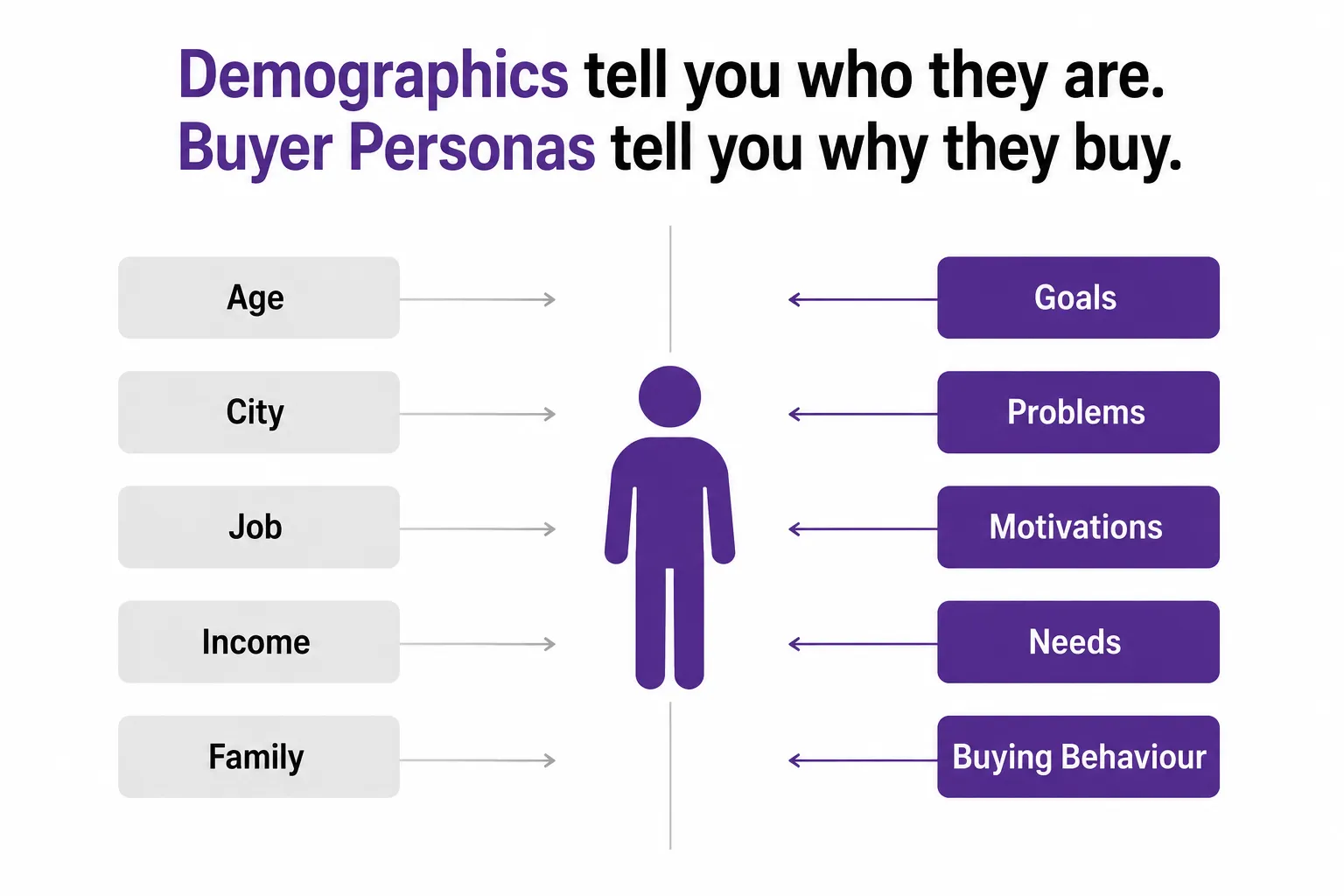
This is the whole buyer persona framework: behaviours and motivations on one side, barriers and expectations on the other, mapped across every person who shapes the decision. It is not a profile but a working tool you argue with.
The brands pulling ahead are not the ones with the most polished persona deck. They are the ones whose personas are open on the table when a real decision gets made, and whose maps account for everyone in the room, not a single invented avatar.
The shift is simple to name and hard to do. Stop describing your customer and start mapping how they decide. Stop building one persona for one imaginary buyer, and start answering the specific objection each real decider brings.
Do that, and the buyer persona stops being a document you made once and forgot. It becomes the thing you reach for every time the work gets hard and a real call has to be made.
A worksheet sits in a drawer. A map shows you the room where the decision actually gets made.
A buyer persona is a model of how your customer decides to buy, built from their behaviours, motivations, barriers, and expectations. The useful version is not a demographic profile of who the customer is. It is a decision map that explains what moves them, what stops them, and what they need to see before they act.
A target audience is a broad group defined by shared attributes like age, location, or industry. A buyer persona goes deeper, modelling how a specific kind of buyer actually makes a decision. The audience tells you who might buy. The persona tells you why they would, and what would stop them.
Start from a real buying decision you want to win, then interview recent buyers and walk-aways about what they were trying to get done and what almost stopped them. Map every person who shapes the decision, not just one avatar, and write each insight as a rule the team can act on. Then test it against a live campaign call.
Most personas fail because they are built on demographics and assumptions rather than real behaviour. They describe who a customer is without explaining how they decide, so teams never actually use them. A persona that never changes a decision is a worksheet, not a working tool.
Usually more than one. Even a household purchase tends to involve several people: the one who first wants it, those who influence the choice, the one who pays, and the one who uses it. Philip Kotler's classic five buying roles describe a single purchase as a small cast, not a solo act. A persona built around one avatar misses the others who can still change the outcome.


.svg)

.svg)
.svg)


